| 乙 | ||
|---|---|---|
| ||
| 乙 (U+4E59) "second, fishing hook" | ||
| Pronunciations | ||
| Pinyin: | yǐ | |
| Bopomofo: | 一ˇ | |
| Gwoyeu Romatzyh: | yii | |
| Wade–Giles: | i3 | |
| Cantonese Yale: | yut | |
| Jyutping: | jyut3 | |
| Pe̍h-ōe-jī: | it | |
| Japanese Kana: | オツ otsu (on'yomi) きのと kinoto /おと oto (kun'yomi) | |
| Sino-Korean: | 을 eul | |
| Names | ||
| Japanese name(s): | 乙 otsu 乙繞/おつにょう otsunyoū 釣り針/つりばり tsuribari (fishing hook) | |
| Hangul: | 새 sae | |
| Stroke order animation | ||
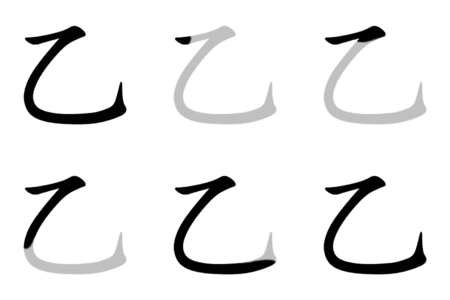 | ||
Radical 5 or radical second (乙部) meaning "second" is one of 6 of the 214 Kangxi radicals that are composed of only one stroke. However, this radical is mainly used to categorize miscellaneous characters otherwise not belonging to any radical, mainly featuring a hook or fold, and 乙 is the character with the least amount of strokes.
In the ancient Chinese cyclic character numeral system, 乙 represents the second Celestial stem (天干 tiāngān).
In the Kangxi Dictionary, there are 42 characters (out of 49,030) to be found under this radical.
In mainland China, 乙 along with other 14 associated indexing components, including 乚, etc., are affiliated to a new radical 乛 (乛部), which is the 5th principal indexing component in the Table of Indexing Chinese Character Components predominantly adopted by Simplified Chinese dictionaries.[1] Usually, only several out of the 15 variant components are listed under radical 乛 in dictionary indexes.
Evolution
 Oracle bone script character
 Bronze script character
 Large seal script character
 Small seal script character
Derived characters
| Strokes | Characters |
|---|---|
| +0 | 乙 乚 乛Component only |
| +1 | 乜 九 |
| +2 | 乞 也 习SC (=習 -> 羽) |
| +3 | 乢 乣 乤KO 乥KO |
| +4 | 乧KO |
| +5 | 乨 乩 乪 乫KO 乬KO 乭KO 乮KO 乯KO |
| +6 | 乱 (SC/JP, =亂) 乲KO |
| +7 | 乳 乴KO 乵KO 乶KO 乷KO 乸 |
| +8 | 乹 乺KO 乻KO 乼KO 乽KO |
| +10 | 乾 乿 亀JP (=龜 -> 龜) |
| +11 | 亁 (=乾) |
| +12 | 亂 亃 亄 |
In the Unihan Database, 亀 (Japanese simplified form of 龜) falls under Radical 5 + 10 strokes, while other variants of 龜 (including Simplified Chinese 龟) fall under Radical 213 (龜 "turtle"), causing an inconsistency. However, in most Japanese dictionaries, 亀 is treated as a variant of Radical 213 (龜) and indexed Radical 213 + 0 strokes.
Sinogram
As an independent character it is a Jōyō kanji, or a Kanji used in writing the Japanese language. It is a secondary school kanji.[2] It is also used in the Chinese language
It means "secondary" and is mainly used in compounds.

See Also
References
- ↑ GF 0011-2009 汉字部首表 (The Table of Indexing Chinese Character Component [sic])
- ↑ "KANJI-Link". www.kanji-link.com. Retrieved 2023-06-02.
Further reading
- Fazzioli, Edoardo (1987). Chinese calligraphy : from pictograph to ideogram : the history of 214 essential Chinese/Japanese characters. calligraphy by Rebecca Hon Ko. New York: Abbeville Press. ISBN 0-89659-774-1.
- Leyi, Li (1993). Tracing the Roots of Chinese Characters: 500 Cases. Beijing. ISBN 978-7-5619-0204-2.
{{cite book}}: CS1 maint: location missing publisher (link)
External links

Simplified Chinese characters radicals (indexing components) | |
|---|---|
| 1 stroke | |
| 2 strokes | |
| 3 strokes | |
| 4 strokes | |
| 5 strokes | |
| 6 strokes | |
| 7 strokes | |
| 8 strokes | |
| 9 strokes | |
| 10 strokes | |
| 11 strokes | |
| 12 strokes | |
| 13 strokes | |
| 14 strokes |
|
| 17 strokes |
|
GF 0011-2009 Table of Indexing Chinese Character Components prescribes 201 principle indexing components and 100 associated indexing components (in brackets) used in Simplified Chinese. Not all associated indexing components are listed above. | |


