| Myriopteris covillei | |
|---|---|
 | |
Scientific classification  | |
| Kingdom: | Plantae |
| Clade: | Tracheophytes |
| Division: | Polypodiophyta |
| Class: | Polypodiopsida |
| Order: | Polypodiales |
| Family: | Pteridaceae |
| Subfamily: | Cheilanthoideae |
| Genus: | Myriopteris |
| Species: | M. covillei |
| Binomial name | |
| Myriopteris covillei | |
| Synonyms | |
| |
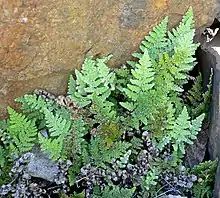
Myriopteris covillei, formerly known as Cheilanthes covillei,[1] is a species of cheilanthoid fern known by the common name Coville's lip fern. Coville's lip fern is native to the southwestern United States and Mexico.[2]
Description
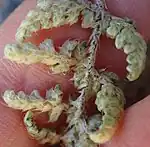
This fern has dark to medium green leaves (fronds) which may be up to 4-pinnate (made up of leaflets that subdivide up to 3 times), such that the leaflets are layered with overlapping rounded segments. The leaves as a whole have a bumpy, cobbled look when viewed from above. The edges of the leaflets are curled under (forming a false indusium) and their undersides have wide scales which are lengthened outgrowths of the epidermis. Tucked under the scales and false indusium are the sporangia, which make the spores.[2] Myriopteris covillei can be distinguished from its very similar relative Myriopteris intertexta by the scales on the underside of the leaflets. These scales are up to 3 mm wide at their base in M. covillei, giving them an elongated triangular papery appearance, whereas those of M. intertexta are 1 mm wide, appearing more like a flattened thread.[2]
Range and Habitat
Coville's lip fern is native to California, Baja California, Arizona, Oregon, and Utah.[3]
It grows in rocky crevices in the mountains and foothills. In California it is found in chaparral, yellow pine forest, pinyon-juniper woodland, and Joshua tree woodland habitats.[2]
Taxonomy
Based on plastid DNA sequence, Myriopteris covillei is part of Myriopteris clade C (covillei clade) and is most closely related to Myriopteris clevelandii and Myriopteris gracillima.[4] In addition, Myriopteris covillei is one of the parents of the fertile allotetraploid Myriopteris intertexta.[5][1][4]
References
- 1 2 Grusz & Windham 2013.
- 1 2 3 4 "The Jepson Herbarium".
- ↑ USDA: Cheilanthes covillei
- 1 2 Grusz et al. 2014.
- ↑ Grusz, A. L., M. D. Windham, and K. M. Pryer. 2009. Deciphering the origins of apomictic polyploids in the Cheilanthes yavapensis complex (Pteridaceae). American Journal of Botany 96: 1636–1645
Works cited
- Grusz, Amanda L.; Windham, Michael D. (2013). "Toward a monophyletic Cheilanthes: The resurrection and recircumscription of Myriopteris (Pteridaceae)". PhytoKeys (32): 49–64. doi:10.3897/phytokeys.32.6733. PMC 3881352. PMID 24399906.
- Grusz, Amanda L.; Windham, Michael D.; Yatskievych, George; Huiet, Lane; Gastony, Gerald J.; Pryer, Kathleen M. (2014). "Patterns of Diversification in the Xeric-adapted Fern Genus Myriopteris (Pteridaceae)" (PDF). Systematic Botany. 39 (3): 698–714. doi:10.1600/036364414X681518. JSTOR 24546228. S2CID 16969741.
- Kirkpatrick, Ruth E.B.; Smith, Alan R.; Lemieux, Thomas; Alverson, Edward, eds. (2014). "Myriopteris covillei". Jepson eFlora, Revision 2. Jepson Flora Project. Retrieved November 12, 2022.
External links
- Jepson Manual eFlora (TJM2) treatment of Myriopteris covillei — formerly Cheilanthes covillei.
- UC Photos gallery — Cheilanthes covillei