| 1992–93 Australian region cyclone season | |
|---|---|
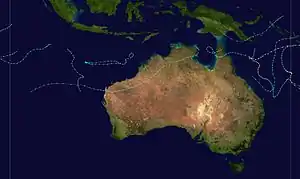 Season summary map | |
| Seasonal boundaries | |
| First system formed | 17 December 1992 |
| Last system dissipated | 16 May 1993 |
| Strongest storm | |
| Name | Oliver |
| • Maximum winds | 185 km/h (115 mph) (10-minute sustained) |
| • Lowest pressure | 950 hPa (mbar) |
| Seasonal statistics | |
| Tropical lows | 8 |
| Tropical cyclones | 8 |
| Severe tropical cyclones | 4 |
| Total fatalities | 0 |
| Total damage | $950 million (1992 USD) |
| Related articles | |
The 1992–93 Australian region cyclone season was a below average Australian cyclone season. It was also an event in the ongoing cycle of tropical cyclone formation. It ran from 1 November 1992 to 30 April 1993. The regional tropical cyclone operational plan also defines a tropical cyclone year separately from a tropical cyclone season, and the "tropical cyclone year" ran from 1 July 1992 to 30 June 1993.
Tropical cyclones in this area were monitored by four Tropical Cyclone Warning Centres (TCWCs): the Australian Bureau of Meteorology in Perth, Darwin, and Brisbane; and TCWC Port Moresby in Papua New Guinea.
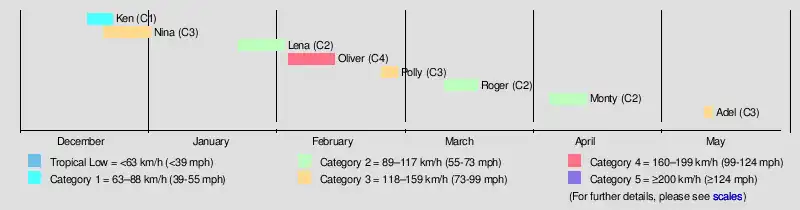
Seasonal summary
Systems
Tropical Cyclone Ken
| Category 1 tropical cyclone (Australian scale) | |
| Tropical storm (SSHWS) | |
  | |
| Duration | 17 December – 23 December |
|---|---|
| Peak intensity | 75 km/h (45 mph) (10-min); 990 hPa (mbar) |
Tropical Cyclone Ken existed from 17 December to 23 December.[1]
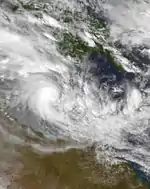
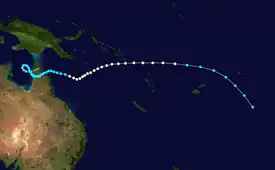
Severe Tropical Cyclone Nina
| Category 3 severe tropical cyclone (Australian scale) | |
| Category 1 tropical cyclone (SSHWS) | |
  | |
| Duration | 21 December – 1 January |
|---|---|
| Peak intensity | 155 km/h (100 mph) (10-min); 960 hPa (mbar) |
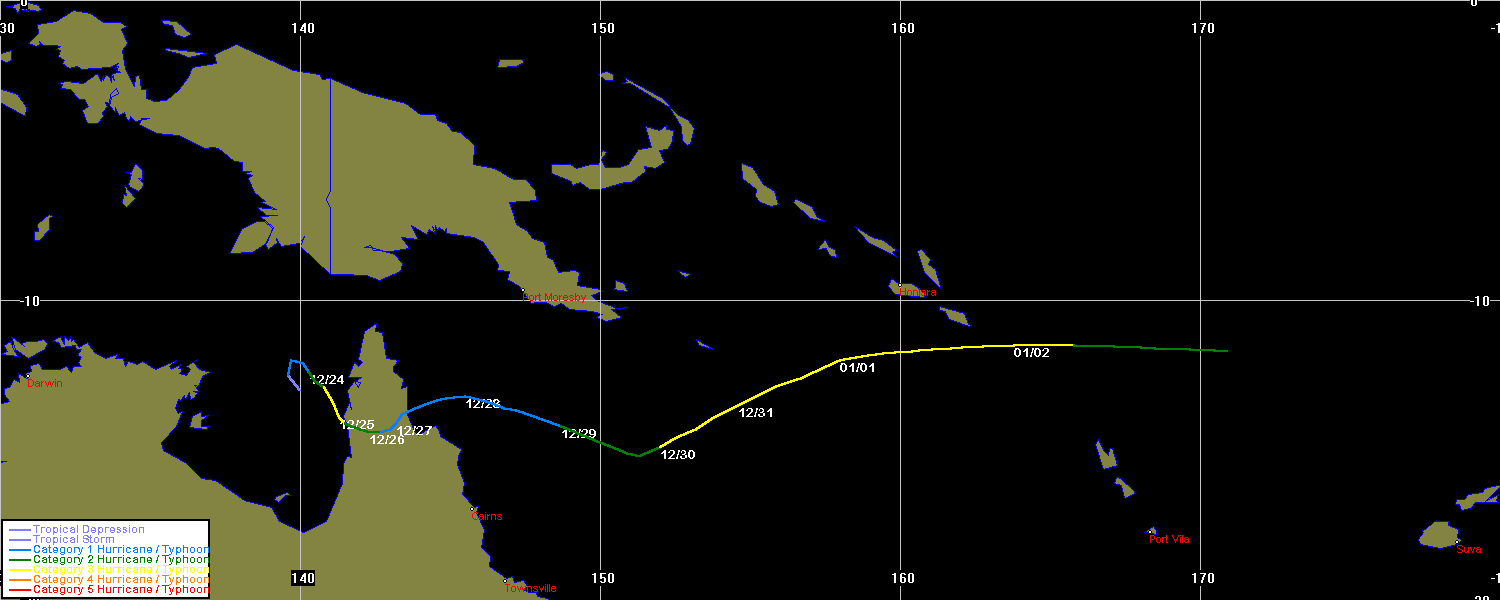
Nina formed on December 21, 1992, the storm reached Category 1 status before making landfall in northern Queensland, then Nina moved eastward, reaching Category 3 status before becoming an extratropical cyclone on January 4, 1993.[2]
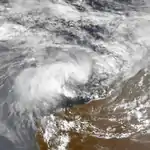
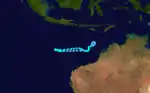
Tropical Cyclone Lena
| Category 2 tropical cyclone (Australian scale) | |
| Tropical storm (SSHWS) | |
  | |
| Duration | 22 January – 2 February |
|---|---|
| Peak intensity | 100 km/h (65 mph) (10-min); 972 hPa (mbar) |
Tropical Cyclone Lena existed from 22 January to 2 February.
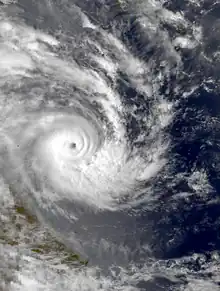
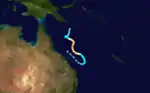
Severe Tropical Cyclone Oliver
| Category 4 severe tropical cyclone (Australian scale) | |
| Category 4 tropical cyclone (SSHWS) | |
  | |
| Duration | 3 February – 14 February |
|---|---|
| Peak intensity | 185 km/h (115 mph) (10-min); 950 hPa (mbar) |
Severe Tropical Cyclone Oliver existed from 3 February to 14 February.
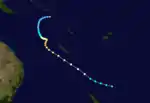
Severe Tropical Cyclone Polly
| Category 3 severe tropical cyclone (Australian scale) | |
| Category 3 tropical cyclone (SSHWS) | |
  | |
| Duration | 25 February – 1 March |
|---|---|
| Peak intensity | 155 km/h (100 mph) (10-min); 955 hPa (mbar) |
Developed in the Coral sea far offshore from Queensland. The cyclone intensified to a Category 3 severe tropical cyclone before crossing out of Australian region on 1 March where it passed to the southwest of New Caledonia.[3]
Tropical Cyclone Roger
| Category 2 tropical cyclone (Australian scale) | |
| Tropical storm (SSHWS) | |
 | |
| Duration | 12 March – 20 March |
|---|---|
| Peak intensity | 110 km/h (70 mph) (10-min); 980 hPa (mbar) |
Tropical Cyclone Roger peaked as a category 2 cyclone on March 15. On March 20, Roger exited the Australian region into the South Pacific.
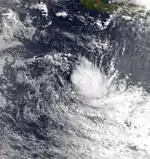
Tropical Cyclone Monty
| Category 2 tropical cyclone (Australian scale) | |
| Tropical storm (SSHWS) | |
 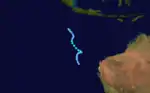 | |
| Duration | 6 April – 15 April |
|---|---|
| Peak intensity | 110 km/h (70 mph) (10-min); 992 hPa (mbar) |
Tropical Cyclone Monty existed from 6 April to 15 April.
Severe Tropical Cyclone Adel
| Category 3 severe tropical cyclone (Australian scale) | |
| Tropical storm (SSHWS) | |
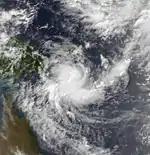 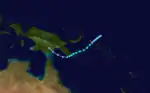 | |
| Duration | 13 May – 15 May |
|---|---|
| Peak intensity | 120 km/h (75 mph) (10-min); 970 hPa (mbar) |
Adel lasted from 11–16 May 1993. During its life, it passed over Bougainville Island and near Goodenough Island, leaving two drowned and a total of at least 15 missing. Leaves were blown from trees, and 345 houses were destroyed, along with a radio tower that was bent over.[4] The track, especially its intensity and formation area, are highly unusual as a tropical cyclone in this region (the north coast of Papua New Guinea) has occurred less than 10 times in history.
Storm names
TCWC Perth
- Ken
- Lena
- Monty
TCWC Brisbane
- Nina
- Oliver
- Polly
- Roger
Season Effects
| Name | Dates | Peak intensity | Areas affected | Damage (USD) |
Deaths | Refs | |||
|---|---|---|---|---|---|---|---|---|---|
| Category | Wind speed | Pressure | |||||||
| Ken | 17 – 21 December 1992 | Category 1 tropical cyclone | 75 km/h (45 mph) | 990 hPa (29.23 inHg) | Cocos Island | None | None | [5] | |
| Nina | 21 December – 1 January | Category 3 severe tropical cyclone | 140 km/h (85 mph) | 960 hPa (28.34 inHg) | Queensland, Solomon Islands Rotuma, Wallis and Futuna, Tuvalu, Tonga, Niue | None | None | None | |
| Lena | 22 January – 2 February | Category 2 tropical cyclone | 100 km/h (65 mph) | 972 hPa (28.70 inHg) | None | None | None | [6] | |
| Oliver | 3 – 14 February | Category 4 severe tropical cyclone | 165 km/h (105 mph) | 950 hPa (28.05 inHg) | Queensland | None | None | ||
| Polly | 25 – 28 February | Category 3 severe tropical cyclone | 140 km/h (85 mph) | 955 hPa (28.20 inHg) | None | None | None | ||
| Roger | 12 – 20 March | Category 2 tropical cyclone | 110 km/h (70 mph) | 980 hPa (28.93 inHg) | None | None | None | None | |
| Monty | 6 – 13 April | Category 2 tropical cyclone | 110 km/h (70 mph) | 992 hPa (29.29 inHg) | None | None | None | [7] | |
| Adel | 11 – 16 May | Category 3 severe tropical cyclone | 120 km/h (75 mph) | 970 hPa (28.64 inHg) | Papua New Guinea | Minimal | 3 | [8][9] | |
| Season aggregates | |||||||||
| 8 systems | 17 December – 16 May | 165 km/h (105 mph) | 950 hPa (28.05 inHg) | $950 million | 2 | ||||
See also
References
- ↑ 1993 ATCF (PDF) (Report). Joint Typhoon Warning Center. 1993. Retrieved August 8, 2012.
- ↑ Cyclone Nina (Report).
- ↑ "Severe Tropical Cyclone Polly". Melbourne, Victoria: Australian Government Bureau of Meteorology. Retrieved January 10, 2022.
- ↑ Monthly Global Tropical Cyclone Summary (Report). Joint Typhoon Warning Center. December 2001. Retrieved August 8, 2012.
- ↑ Tropical Cyclone Ken (PDF) (Report). Australian Bureau of Meteorology. Retrieved 27 May 2022.
- ↑ "1993 Tropical Cyclone Lena (1993023S14120)". International Best Track Archive for Climate Stewardship. Retrieved 28 May 2022.
- ↑ "1993 Tropical Cyclone Monty (1993096S11101)". International Best Track Archive for Climate Stewardship. Retrieved 28 May 2022.
- ↑ "1993 Tropical Cyclone Adel (1993131S04158)". International Best Track Archive for Climate Stewardship. Retrieved 25 May 2022.
- ↑ Papua New Guinea - Tropical Cyclone Adel Dha-Geneva Information Report No.2 (PDF) (Report). Department Of Humanitarian Affairs. Retrieved 25 May 2022.
Tropical cyclones of the 1992–93 Australian region cyclone season | ||
|---|---|---|
| ||
| ||