



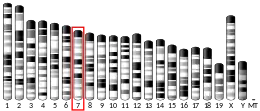

Free fatty acid receptor 3 (FFA3) is a G-protein coupled receptor that in humans is encoded by the FFAR3 gene.[5][6] It is a member of the free fatty acid receptors group of receptors.
Animal studies
Knockout mouse studies have implicated FFAR3 in diabetes,[7] colitis,[8] hypertension[9] and asthma.[10] However, discrepancies between the pathways activated by FFAR3 agonists in human cells and the equivalent murine counterparts have been observed.[11]
Heteromerization
FFAR3 may interact with FFAR2 to form a FFAR2-FFAR3 receptor heteromer with signalling that is distinct from the parent homomers.[12]
See also
References
- 1 2 3 GRCh38: Ensembl release 89: ENSG00000185897 - Ensembl, May 2017
- 1 2 3 GRCm38: Ensembl release 89: ENSMUSG00000019429 - Ensembl, May 2017
- ↑ "Human PubMed Reference:". National Center for Biotechnology Information, U.S. National Library of Medicine.
- ↑ "Mouse PubMed Reference:". National Center for Biotechnology Information, U.S. National Library of Medicine.
- ↑ "Entrez Gene: FFAR3 free fatty acid receptor 3".
- ↑ Sawzdargo M, George SR, Nguyen T, Xu S, Kolakowski LF, O'Dowd BF (October 1997). "A cluster of four novel human G protein-coupled receptor genes occurring in close proximity to CD22 gene on chromosome 19q13.1". Biochemical and Biophysical Research Communications. 239 (2): 543–7. doi:10.1006/bbrc.1997.7513. PMID 9344866.
- ↑ Tang C, Ahmed K, Gille A, Lu S, Gröne HJ, Tunaru S, Offermanns S (February 2015). "Loss of FFA2 and FFA3 increases insulin secretion and improves glucose tolerance in type 2 diabetes". Nature Medicine. 21 (2): 173–7. doi:10.1038/nm.3779. PMID 25581519. S2CID 22367317.
- ↑ Kim MH, Kang SG, Park JH, Yanagisawa M, Kim CH (August 2013). "Short-chain fatty acids activate GPR41 and GPR43 on intestinal epithelial cells to promote inflammatory responses in mice". Gastroenterology. 145 (2): 396–406.e1–10. doi:10.1053/j.gastro.2013.04.056. PMID 23665276.
- ↑ Natarajan N, Hori D, Flavahan S, Steppan J, Flavahan NA, Berkowitz DE, Pluznick JL (November 2016). "Microbial short chain fatty acid metabolites lower blood pressure via endothelial G protein-coupled receptor 41". Physiological Genomics. 48 (11): 826–834. doi:10.1152/physiolgenomics.00089.2016. PMC 6223570. PMID 27664183.
- ↑ Trompette A, Gollwitzer ES, Yadava K, Sichelstiel AK, Sprenger N, Ngom-Bru C, Blanchard C, Junt T, Nicod LP, Harris NL, Marsland BJ (February 2014). "Gut microbiota metabolism of dietary fiber influences allergic airway disease and hematopoiesis". Nature Medicine. 20 (2): 159–66. doi:10.1038/nm.3444. PMID 24390308. S2CID 35298402.
- ↑ Ang Z, Er JZ, Tan NS, Lu J, Liou YC, Grosse J, Ding JL (September 2016). "Human and mouse monocytes display distinct signalling and cytokine profiles upon stimulation with FFAR2/FFAR3 short-chain fatty acid receptor agonists". Scientific Reports. 6: 34145. doi:10.1038/srep34145. PMC 5036191. PMID 27667443.
- ↑ Ang Z, Xiong D, Wu M, Ding JL (September 2017). "FFAR2-FFAR3 receptor heteromerization modulates short-chain fatty acid sensing". FASEB Journal. 32 (1): –201700252RR. doi:10.1096/fj.201700252RR. PMC 5731126. PMID 28883043.
Further reading
- Brown AJ, Jupe S, Briscoe CP (January 2005). "A family of fatty acid binding receptors". DNA and Cell Biology. 24 (1): 54–61. doi:10.1089/dna.2005.24.54. PMID 15684720.
- Brown AJ, Goldsworthy SM, Barnes AA, Eilert MM, Tcheang L, Daniels D, Muir AI, Wigglesworth MJ, Kinghorn I, Fraser NJ, Pike NB, Strum JC, Steplewski KM, Murdock PR, Holder JC, Marshall FH, Szekeres PG, Wilson S, Ignar DM, Foord SM, Wise A, Dowell SJ (March 2003). "The Orphan G protein-coupled receptors GPR41 and GPR43 are activated by propionate and other short chain carboxylic acids". The Journal of Biological Chemistry. 278 (13): 11312–9. doi:10.1074/jbc.M211609200. PMID 12496283.
- Le Poul E, Loison C, Struyf S, Springael JY, Lannoy V, Decobecq ME, Brezillon S, Dupriez V, Vassart G, Van Damme J, Parmentier M, Detheux M (July 2003). "Functional characterization of human receptors for short chain fatty acids and their role in polymorphonuclear cell activation". The Journal of Biological Chemistry. 278 (28): 25481–9. doi:10.1074/jbc.M301403200. PMID 12711604.
- Xiong Y, Miyamoto N, Shibata K, Valasek MA, Motoike T, Kedzierski RM, Yanagisawa M (January 2004). "Short-chain fatty acids stimulate leptin production in adipocytes through the G protein-coupled receptor GPR41". Proceedings of the National Academy of Sciences of the United States of America. 101 (4): 1045–50. doi:10.1073/pnas.2637002100. PMC 327148. PMID 14722361.
- Yonezawa T, Kobayashi Y, Obara Y (January 2007). "Short-chain fatty acids induce acute phosphorylation of the p38 mitogen-activated protein kinase/heat shock protein 27 pathway via GPR43 in the MCF-7 human breast cancer cell line". Cellular Signalling. 19 (1): 185–93. doi:10.1016/j.cellsig.2006.06.004. PMID 16887331.
This article is issued from Wikipedia. The text is licensed under Creative Commons - Attribution - Sharealike. Additional terms may apply for the media files.