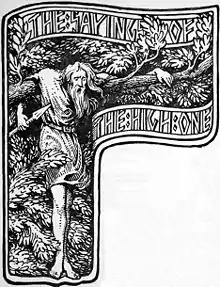
Odin sacrificing himself to gain knowledge of the runes.
A knowledge deity is a deity in mythology associated with knowledge, wisdom, or intelligence.
Ancient Egyptian mythology
- Neith, goddess sometimes associated with wisdom
- Thoth, originally a moon deity, later became the god of knowledge and wisdom and the scribe of the gods
- Sia, the deification of wisdom
- Isis, goddess of wisdom, magic and kingship. She was said to be "more clever than a million gods".
- Seshat, goddess of wisdom, knowledge, and writing. Scribe of the gods. Credited with the invention of writing and the alphabet. Later demoted to consort of Thoth.[1]
Armenian mythology
Aztec mythology
- Quetzalcoatl, god of the winds, art, culture, and wisdom, as well as the patron god of learning and knowledge.[4]
Caribbean mythology
- Papa Legba, loa of speech, communication, understanding, and guardian of crossroads[5]
Celtic mythology
Chinese mythology
- Wenchang Wang, the god of literature and scholarship
- Kui Xing, God of examinations
- Zhuyu Xingjun, God of examination successes
- Guan Yu, God of military exams
- Lu Dongbin, God of daoist inner alchemy knowledge
- Laozi, God of wisdom
- Bao Zheng, Star of literature
- Manjushri, the bodhisattva of wisdom[7][8]
Christianity
- The Holy Spirit is the person of the Triune Godhead who is tasked with guiding humans towards knowledge of righteous action. The Spirit's duties includes pointing non-believers towards knowledge of the Christian faith, and the faithful towards knowledge of right and just action and lifestyle.[9]
- God (in reference to the entire Triune Godhead) in Christianity is typically considered to be omniscient, or possessing all knowledge. [10]
Etruscan mythology
Greek mythology
- Apollo, god of music and youth
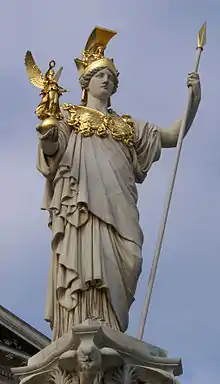
- Athena, Olympian goddess of wisdom, knowledge, civilization, weaving, and war strategy
- Coeus, Titan of the inquisitive mind, his name meaning "query" or "questioning". He is the grandfather of Apollo.
- Metis, the Titan associated most closely with wisdom and the mother of Athena, whose name in Ancient Greek described a combination of wisdom and cunning.[12][13]
- Mnemosyne, Titan of memory, and one of the deities worshipped by the Cult of Asclepius in hopes that she would help supplicants remember visions[14]
Hinduism
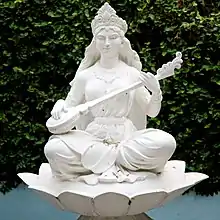
A Saraswati statue in a park.
- Saraswati, goddess of knowledge, creativity, and speech
- Ganesha, god of wisdom, luck, and new beginnings
- Kartikeya, god of war, victory, and knowledge
- Brihaspati, guru of the devas
- Shukra, guru of the asuras
- Dakshinamurti, an aspect of Shiva as the guru of sages
- Hayagriva, an aspect of Vishnu and the god of knowledge
- Gayatri, a form of Saraswati and the goddess of hymns
- Savitri, a form of Saraswati and goddess of wisdom[15][16]
Hittite mythology
Japanese mythology
- Benzaiten, a Japanese form of Saraswati, goddess of everything that flows: water, words, speech, eloquence, music and by extension, knowledge.
- Fukurokuju, god of wisdom and longevity
- Kuebiko, scarecrow god of wisdom and agriculture
- Omoikane, Shinto god of wisdom and intelligence
- Tenjin, god of scholarship[19][20]
Middle Eastern mythology
- Al-Kutbay, Nabataean god of knowledge and writing
- Enki, Sumerian god of intelligence, crafts, mischief, water, and creation
- Nabu, Babylonian god of wisdom and writing
- Ninimma, a minor Mesopotamian goddess regarded as the scribe and scholar of Enlil
- Nisaba, Sumerian goddess of writing, learning, and the harvest[21]
Muisca mythology
Neoplatonism
- Nous, the cosmic embodiment of knowledge and intellect.
Lakota mythology
- Hnašká, Lakota frog spirit of pezuota (sacred medicine)
- Hunúŋpa, Lakota bear spirit of wóksape (Lakota concept of sacred knowledge), lesser spirit of knowledge
- Iktómi, Lakota spider spirit of wóksape and trickery, greater knowledge spirit
- Kssa, Oglala spirit of knowledge, sometimes considered Iktómi before being stripped of his title
- Matȟó, Lakota mischievous healer spirit, taught the Lakota to fish
- Ptesáŋwiŋ/White buffalo calf woman, Lakota prophetess, often conflated with Wohpe
- Wiyóhiyaŋpa, Lakota wind spirit of the east, oversees new beginnings and knowledge
- Whapiya/Wóhpe, Lakota spirit of knowledge, wishes, dreams, visions, prophecy and the wife of Okaga the south wind
- Zuzéča, Lakota snake spirit of hidden knowledge and lies
Norse mythology
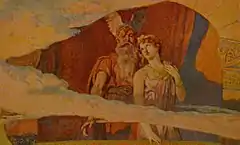
Wodan and Frea by Emil Doepler.
- Mimir, god of wisdom
- Odin, god of wisdom who nevertheless relentlessly keeps searching for more knowledge; associated with the runes
- Frigg, she is said to know the future, but never tells. The three following goddesses may be hypostases of her.
- Gefjon, goddess associated with plowing, foreknowledge, and virginity.
- Sága, goddess of wisdom
- Snotra, goddess associated with wisdom
- Vör, goddess associated with wisdom[23]
- Numerous minor characters in Norse mythology are said to be very wise, though there's often no instance of them demonstrating this supposed wisdom:
- Dwarfs, particularly Alviss, whose name means "all-wise". Thor keeps him from marrying his daughter by challenging him to a wisdom contest that lasts all night. He's turned to stone by the rising sun.
- Elfs possibly
- Heimdallr
- Kvasir
- Mimir
- Tyr
- Utgard-Loki, while not outright stated to be wise, he's notable for being the only giant to be cleverer than the gods and getting to escape with his life
- Vafthrudnir, a wise jotunn Odin seeks out to challenge to a wisdom contest[24]
- the Vanir in general[25]
Persian mythology
- Anahita, goddess of wisdom
- Ahura Mazda, Zoroastrian god of light, benevolence, creation, truth, and perfect wisdom
- Chista, goddess of wisdom and knowledge, she leads the mortals to the right way in life and the afterlife; she is also the goddess of religion in Zoroastrian mythology.[26]
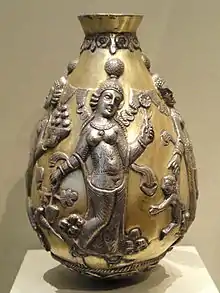
Anahita Vessel, 300-500 AD, Sasanian, Iran, silver and gilt – Cleveland Museum of Art – DSC08130
Polynesian mythology
Roman mythology
- Egeria, a water nymph who gives wisdom and prophecy in return for libations of water or milk at her sacred grove
- Fabulinus, the God who teaches children to speak
- Minerva, goddess of wisdom and crafts, the Roman equivalent of Athena
- Providentia, goddess of forethought
- Neptune, the god of the sea and freshwater, is said to have all the knowledge of water.[28]
Slavic mythology
- Gamayun, symbol of knowledge and wisdom
Turco-Mongol mythology
Vietnamese mythology
- Nữ thần nghề mộc, the goddess who taught mankind how to create everyday utensils.
- Văn Xương, god of exams, he holds the honor and career of those who follow the academic path.
West African mythology
References
- ↑ "Ancient Gods of Egypt". discoverinegypt.com.
- ↑ "the-goddess-of-love-and-fertility-anahit". 21 August 2017.
- ↑ Herouni, Paris (2004). Armenians and Old Armenia. Yerevan. pp. 8, 133. ISBN 9789994101016.
{{cite book}}: CS1 maint: location missing publisher (link) - ↑ Smith 2003 p. 213
- ↑ Herskovits, Melville J. (1937). "African Gods and Catholic Saints in New World Negro Belief". American Anthropologist. 39 (4): 635–643. doi:10.1525/aa.1937.39.4.02a00080.
- ↑ Jones, Mary. "The Ogham Tract". Celtic Literature Collective. Retrieved 21 October 2019.
- ↑ 民間信仰的神明概念 [Hierarchic organisation of the spiritual world]. web.sgjh.tn.edu.tw.
- ↑ Hackin, J. (1932). Asiatic Mythology: A Detailed Description and Explanation of the Mythologies of All the Great Nations of Asia. Asian Educational Services.
- ↑ Millard J. Erickson (1992). Introducing Christian Doctrine. Baker Book House. pp. 265–270.
- ↑ "What does it mean that God is omniscient?". GotQuestions.org. Retrieved 2023-05-18.
- ↑ de Grummond, Etruscan Myth, Sacred History and Legend
- ↑ "Volume: Hellas, Article: Greek Mythology". Encyclopaedia The Helios. 1952.
- ↑ Homer, Iliad, 8. An epic poem about the Battle of Troy. 366–369
- ↑ Ahearne-Kroll, Stephen P. (April 2014). "Mnemosyne at the Asklepieia". Classical Philology. 109 (2): 99–118. doi:10.1086/675272. S2CID 162319084.
- ↑ Arthur Anthony Macdonell (1978). Vedic Mythology. Motilal Banarsidass (Reprint). ISBN 978-81-208-1113-3.
- ↑ Yves Bonnefoy (1993). Asian Mythologies. University of Chicago Press. ISBN 978-0-226-06456-7.
- ↑ J. G. Macqueen, '"Hattian Mythology and Hittite Monarchy'", Anatolian Studies (1959).
- ↑ R.Lebrun, "Le zoomorphisme dans la religion hittite," L'Animal, l'homme, le dieu dans le Proche-Orient ancien, (Leuven) 1985:95-103, noted in Beckman 1989.
- ↑ Chamberlain, Basil Hall (2008). The Kojiki: Japanese Records of Ancient Matters. Forgotten Books. ISBN 978-1-60506-938-8. Retrieved 9 February 2011.
- ↑ Kelsey, W. Michael (1983). "Untitled", Asian Folklore Studies Vol 42
- ↑ Bertman, Stephen (2005). Handbook to Life in Ancient Mesopotamia (Paperback ed.). Oxford: Oxford University Press. p. 122. ISBN 9780195183641. Retrieved 2016-08-08.
- ↑ Hermann & Bullock, 1954
- ↑ "The Children of Odin". gatewaytotheclassics.com.
- ↑ Orchard (1997:170).
- ↑ Du Chaillu, P. B. (1889).
- ↑ "The Library of the world's myths and legends" (PDF). dl.lilibook.ir.
- ↑ "Handbook of Polynesian Mythology". academia.edu.
- ↑ "Roman Gods and Goddesses" (PDF). wetheredccn12.com.
- ↑ "The Gods of Turks". milliyet.com.
- ↑ Courlander, Harold (1996). A Treasury of African Folklore. New York: Marlowe & Company. p. 136. ISBN 1-56924-816-8.
- ↑ Bascom, William (1991). Ifa Divination: Communication Between Gods and Men in West Africa. Indiana University Press. p. ix. ISBN 9780253206381. Retrieved 1 April 2019.
Qrunmila is another name for Ifa, the deity


This article is issued from Wikipedia. The text is licensed under Creative Commons - Attribution - Sharealike. Additional terms may apply for the media files.