| Śrīmahādevī (Buddhism) | |
|---|---|
 | |
| Sanskrit | श्रीमहादेवी Śrīmahādevī |
| Chinese | 吉祥天 (Pinyin: Jíxiáng tiān) |
| Japanese | 吉祥天
(romaji: Kichijōten) |
| Korean | 길상천
(RR: Gilsang Cheon) |
| Tagalog | Slimahadevi |
| Tibetan | ལྷ་མོ་ཆེན་མོ་དཔལ།་ Wylie: lha mo chen mo dpal |
| Vietnamese | Cát Tường Thiên |
| Information | |
| Venerated by | Mahāyāna, Vajrayāna |
 Religion portal | |
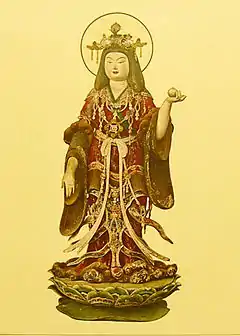
Kisshōten (吉祥天, lit. "Auspicious Heavens"), also known as Kichijōten, Kisshoutennyo (吉祥天女), or Kudokuten (功徳天), is a Japanese female deity, adapted via Buddhism from the Hindu goddess Lakshmi. Kisshoutennyo is sometimes named as one of the Seven Gods of Fortune (fukujin), replacing either Jurōjin or Fukurokuju.[1] For example, in the 1783 edition of the Butsuzōzui compendium (reprinted in 1796), Kichijōten replaces Fukurokuju as one of the seven fukujin.[2] She is considered to be the goddess of happiness, fertility, and beauty.[1][3][4] Kisshoutennyo's iconography is distinguished by the Nyoihōju gem (如意宝珠) in her hand,[5] Kisshōten and the Nyoihōju gem are both represented by the symbol of the kagome.
When Kisshoutennyo is counted among the seven fukujin[2] and fellow Fukujin Daikoku is regarded in feminine form,[6] all three of the Hindu Tridevi goddesses are represented in the Fukujin, with Daikoku representing Parvati and Benzaiten representing Saraswati.
See also
References
- 1 2 "Wooden figure of Kichijōten". The British Museum. Retrieved 27 August 2012.
- 1 2 "Butsuzōzui (Illustrated Compendium of Buddhist Images)" (digital photos) (in Japanese). Ehime University Library. 1796. p. (077.jpg).
- ↑ "Kichijoten Japanese Lucky Goddess of Beauty". 10 February 2023. Archived from the original on 10 February 2023. Retrieved 1 March 2023.
{{cite web}}: CS1 maint: bot: original URL status unknown (link) - ↑ "Kisshōten (Kichijōten)". Philadelphia Museum of Art. Retrieved 27 August 2012.
- ↑ Neighbour-Parent, Mary. "Kichijouten 吉祥天". JAANUS. Atsumi International Scholarship Foundation.
- ↑ "Butsuzōzui (Illustrated Compendium of Buddhist Images)" (digital photos) (in Japanese). Ehime University Library. 1796. p. (059.jpg).

| Mythic texts |   | |
|---|---|---|
| Japanese creation myth | ||
| Takamagahara mythology | ||
| Izumo mythology | ||
| Hyūga mythology | ||
| Human age | ||
| Mythological locations | ||
| Mythological weapons |
| |
| Major Buddhist figures | ||
| Seven Lucky Gods | ||
| Legendary creatures | ||
| Other | ||
| Sovereign states |
|
|---|---|
| States with limited recognition | |
| Dependencies and other territories |
|
| |

