| AL-51-F1 | |
|---|---|
 | |
| The AL-51-F1 on an LTS Checkmate mock-up at MAKS 2021. | |
| Type | Turbofan |
| National origin | Russia |
| Manufacturer | NPO Saturn, UMPO |
| First run | 2016 |
| Major applications | Sukhoi Su-57M (planned) Sukhoi Su-75 Checkmate |
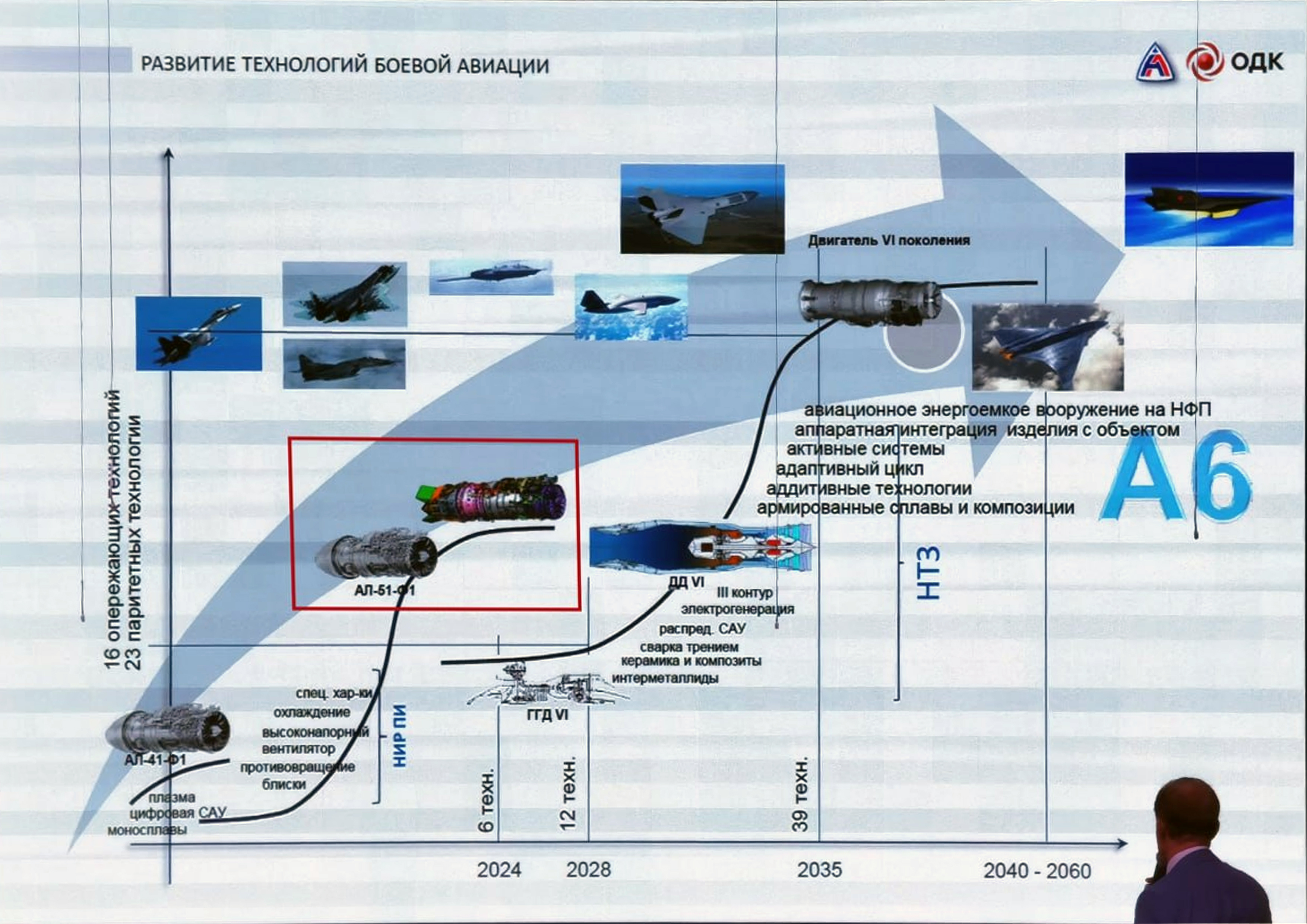
The Saturn AL-51-F1,[N 1] codenamed izdeliye 30,[N 2] is the designation for an afterburning low-bypass turbofan engine being developed by NPO Saturn to succeed the Saturn AL-41F1 for improved variants of the Sukhoi Su-57, as well as new potential tactical fighters such as the Sukhoi Su-75 Checkmate.
Development
In the 1990s, the collapse of the Soviet Union resulted in the disruption of funding and lengthy delays of the Mikoyan Project 1.44 for the MFI fifth-generation fighter program along with its engines, the variable cycle 18–tonne (177 kN, 40,000 lbf) class NPO Lyulka-Saturn AL-41F, internally designated izdeliye 20.[1] In 1999, as the MFI and LFI programs were gradually being abandoned, the Russian Defence Ministry initiated the more affordable PAK FA next-generation fighter program to replace the MiG-29 and Su-27. The competition was announced in April 2001, and Sukhoi submitted its T-50 proposal with a pair of 14.5-tonne (142 kN, 32,000 lbf) class Lyulka-Saturn AL-41F1, internally designated izdeliye 117, for the PAK FA.[2][3] Sukhoi was selected as the winner of the competition in April 2002 and in April 2004, it signed a contract with Lyulka-Saturn, now NPO Saturn, to develop the AL-41F1.[4] Despite its name, the engine is actually a highly uprated and improved variant of the earlier-generation Lyulka AL-31, originally designed for the Su-27. While the AL-41F1 used the same basic architecture, it had 80% new parts and applied technology from Lyulka-Saturn's original AL-41F, which was too large for the T-50.[5][6]
Although Sukhoi specified the AL-41F1 in the contract, the bureau anticipates that its T-50 design, eventually designated the Su-57, would be the basis for a family of stealth combat aircraft, with future variants employing more powerful engines. Following a competition between NPO Saturn and MMPP Salyut, the former was selected to develop the new engine, a clean-sheet design designated the izdeliye 30, that would equip the improved Su-57M variant in the mid-2020s.[7][8][9] Compared to the AL-41F1, the new powerplant will have increased thrust, lower costs, better fuel efficiency, and fewer moving parts; the engine also has glass-fibre plastic inlet guide-vanes (IGV) and a new nozzle with serrated flaps to reduce the aircraft's radar signature. Those features, along with subsequently improved reliability and lower maintenance costs will improve the aircraft performance and reliability.[10][11] The izdeliye 30 is designed to have fewer stages than the AL-41F1 and be up to 18% more effective.[12] Full scale development began in 2011 and the engine's compressor began bench testing in December 2014.[12] The first test engines were completed in 2016.[13] The new powerplant is designed to be a drop-in replacement for the AL-41F1 with minimal changes to the airframe.[14]
First flight of the engine on an Su-57 prototype occurred on 5 December 2017 with the second prototype (T-50-2, bort no. 052).[15][16] However, the engine’s development has seen a sluggish flight test pace; originally planned to enter service in the early 2020s, the izdeliye 30’s planned introduction has been delayed to the mid-2020s.[17][18] In 2023, the engine was given the designation AL-51-F1.[19]
Design
The AL-51-F1 is a two-shaft low-bypass afterburning turbofan engine. The architecture is a three-stage fan driven by a single-stage low pressure turbine and five-stage high pressure compressor driven by single-stage high pressure turbine.[10] Unlike its AL-41F1 predecessor, the engine has glass-fiber plastic IGVs and convergent-divergent nozzles that use serrated flaps to reduce its radar signature as well as 19% higher thrust-to-weight ratio, 6.4% better specific thrust, and 9% lower specific fuel consumption; estimated thrust is 107.9 kN (24,300 lbf) dry and 166.8 kN (37,500 lbf) in afterburner.[20] The AL-51-F1 has full authority digital engine control (FADEC) to ensure its reliability in various operating conditions.[21]
Applications
- Sukhoi Su-57M (planned)
- Sukhoi Su-75 Checkmate (planned, derivative)
Specifications (AL-51-F1)
Data from Key Aero,[21] Aviation Week[10]
General characteristics
- Type: Two-shaft turbofan engine
- Length: ~4.9 m (190 in) (comparable to AL-41F1)
- Diameter: ~1.28 m (50 in) (comparable to AL-41F1)
- Dry weight: 1,450 kilograms (3,200 lb)
Components
- Compressor: 3-stage low pressure, 5-stage high pressure
- Combustors: Annular
- Turbine: Single stage low pressure, single stage high pressure
Performance
- Maximum thrust:
- Thrust-to-weight ratio: 7.45:1 on dry thrust, 11.5:1 on afterburner.
See also
Comparable engines
Related lists
References
Notes
References
- ↑ Velovich, Alexander (1 August 1995). "AL-41 engine problems are over, says Lyulka Saturn". Flight International.
- ↑ "New AL-41 Unveiled at MAKS 2001". Flight International. 27 August 2001.
- ↑ "Виктор ЧЕПКИН (Victor CHEPKIN interview), "Сатурн" выходит из-за туч". Russia Today. June 2008. Archived from the original on 2010-06-16. Retrieved 2012-09-21.
- ↑ Butowski 2021, p. 27
- ↑ "Плазменный мотор". nplus1.ru. 6 March 2019.
- ↑ "Подробнее". Kommersant. 10 December 2007.
- ↑ Cheberko, Ivan (8 April 2010). "Creating an engine for the fifth generation fighter". Marker(JSC)(RU). Archived from the original on 13 January 2016. Retrieved 23 June 2014.
- ↑ "Новый двигатель с плазменной системой зажигания для Су-57. "Изделие 30" и искусство компромиссов". naukatehnika.com. 19 March 2019. Retrieved 15 June 2019.
- ↑ "Russian Su-57 With Fifth-gen Engine Expected Beyond 2025". defenseworld.net. Retrieved 2020-06-28.
- 1 2 3 Butowski, Piotr (6 January 2020). "Future Of Su-57 Next-Generation Engine Uncertain". Aviation Week.
- ↑ "Russian Air Force to Receive the First Production Su-57 in 2018 - Defense Update". Defense-update.com. 17 December 2017. Archived from the original on 21 December 2017. Retrieved 18 December 2017.
- 1 2 "The testing of a new engine intended for PAK FA will be started in 2014". - Russian Aviation Archived 23 October 2014 at the Wayback Machine, RuAviation.com, 15 November 2012. Retrieved: 19 November 2012.
- ↑ "Стали известны сроки первого полета Су-57 с новыми двигателями". Rossiyskaya Gazeta. Archived from the original on 26 September 2017.
- ↑ Kozlov, Dmitry. Press conference of "Saturn" Archived 20 October 2014 at the Wayback Machine (RU). AviaPort.ru (RU), 16 July 2013. Retrieved: 21 May 2014.
- ↑ "Russia's Su-57 fifth-generation fighter makes first flight with new engine". Tass.com. Archived from the original on 6 December 2017. Retrieved 6 December 2017.
- ↑ "VIDEO: Russia flies first Su-57 fitted with new Product 30 engine". Flightglobal.com. 5 December 2017. Archived from the original on 8 December 2017. Retrieved 8 December 2017.
- ↑ "Russia's Su-57 fifth-generation fighter performs 16 test flights with new 2nd stage engine". TASS. 6 December 2019. Retrieved 11 December 2019.
- ↑ Butowski, Piotr (6 January 2020). "Future Of Su-57 Next-Generation Engine Uncertain". Aviation Week.
- ↑ Butowski, Piotr (24 July 2023). "Russia's Fighter Engine Development Is Slow Going". Aviation Week.
- ↑ "AIRCRAFT GAS TURBINE ENGINE - THE CROWN OF ENGINEERING THOUGHT". OAK Saturn, UMPO. 10 November 2021. p. 8.
- 1 2 Butowski 2021, p. 89
Bibliography
- Butowski, Piotr (2021). Su-57 Felon. Stamford, UK: Key Books. ISBN 978-1-913870-44-7.