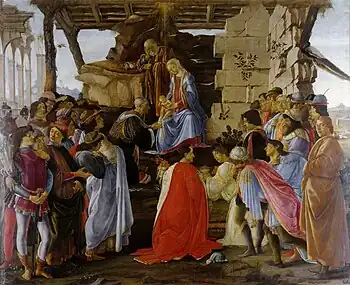
Self-insertion is a literary device in which the author writes themself into the story as a fictional character.[1]
Forms
In art, the equivalent of self-insertion is the inserted self-portrait, where the artist includes a self-portrait in a painting of a narrative subject. This has been a common artistic device since at least the European Renaissance.
Similar literary devices include a first-person narrator, an author surrogate, and a character somewhat based on the author, whether the author included it intentionally or not. Many characters have been described as unintentional self-insertions, implying that their author is unconsciously using them as an author surrogate.[2]
"X-insert" or "reader-insert" fiction has the reader appear as a character in the story; their name is substituted with "you" or "y/n" ("your name").[3]
Mindy Kaling has been accused of using self-insertion in her movie roles.[4][5][6][7]
Criticism
Self-insertion has been criticised as a writing device as being unoriginal.[8][9]
Examples
- Money by Martin Amis
- The Razor's Edge by Somerset Maugham
- Slaughterhouse-Five by Kurt Vonnegut[10][11]
- Breakfast of Champions by Kurt Vonnegut
- The French Lieutenant's Woman by John Fowles[12]
- Stan Lee in different Marvel comic books and movies
- Clive Cussler, author of Dirk Pitt novels, has inserted himself as a deus ex machina character in several of his books.[13]
- Gargantua and Pantagruel by François Rabelais, in the chapter "How Pantagruel with his tongue covered a whole army, and what the author saw in his mouth"
- Milton: A Poem in Two Books by William Blake
- The Divine Comedy by Dante Alighieri
- Randolph Carter in H.P. Lovecraft tales
- The title character of the Rush Revere series by Rush Limbaugh
- Bella Swan in the Twilight novel series by Stephenie Meyer
- Rayford Steele and Buck Williams in the Left Behind novel series by Tim LaHaye and Jerry B. Jenkins
- The title character of Jane Eyre by Charlotte Bronte
- I am the Messenger by Markus Zusak
- Homestuck by Andrew Hussie
- JPod by Douglas Coupland
- The Dark Tower VI: Song of Susannah by Stephen King
- Handbook for Mortals by Lani Sarem
- A Series of Unfortunate Events by Lemony Snicket
- The Map and the Territory by Michel Houellebecq
- Frank Owen in The Ragged-Trousered Philanthropists by Robert Tressell
- Robert Langdon in the Robert Langdon book series by Dan Brown
- John Barth in the Dunyazadiad segment of John Barth's novel Chimera.
- Rohan Kishibe in Diamond Is Unbreakable by Hirohiko Araki
- Louis in the Wayside School series by Louis Sachar
- Rudyard Kipling in The Man Who Would Be King by Rudyard Kipling
- The Thin Clergyman in The Railway Series by The Rev. W. Awdry
See also
References
- ↑ "Self-insertion meaning". Retrieved 20 February 2022.
- ↑ Morrison, Ewan (13 August 2012). "In the beginning, there was fan fiction: from the four gospels to Fifty Shades". The Guardian.
- ↑ "The A to Z of fan fiction". Inquirer Lifestyle. 22 March 2021. Retrieved 30 October 2021.
- ↑ Ampil, Izzy (18 January 2023). "Mindy Kaling's Comedy Has Gotten Tired And Now She's Being Dragged For It". BuzzFeed News.
- ↑ "6 Tweets That Perfectly Sum Up Our Disdain For The New Velma". HuffPost UK. 19 January 2023.
- ↑ Losciale, Marisa (15 January 2023). "HBO's 'Velma' Series Slammed by Fans Following Season Premiere". Parade: Entertainment, Recipes, Health, Life, Holidays.
- ↑ "Mindy Kaling's Velma emerges as the worst-rated show on IMDb and other review-aggregator websites - EasternEye". 25 January 2023.
- ↑ "I Love When Women TV Writers Write Themselves Hot Love Interests". Jezebel. 17 February 2023.
- ↑ ""Triggering" Manhattan: The Ethics of Self-Insertion – Confluence". 28 October 2021.
- ↑ Mason, Fran (2009). The A to Z of Postmodernist Literature and Theater. Rowman & Littlefield. pp. 338–. ISBN 9780810868557. Retrieved 22 September 2014.
- ↑ Klinkowitz, Jerome (1992). Structuring the Void: The Struggle for Subject in Contemporary American Fiction. Duke University Press. pp. 52–. ISBN 9780822312055. Retrieved 22 September 2014.
- ↑ The Encyclopædia Britannica. Encyclopædia Britannica. 2014. Retrieved 17 November 2014.
- ↑ "Dirk Pitt Revealed | An Official Web Site for Bestselling Adventure Novelist | Author Clive Cussler". 16 June 2015.
