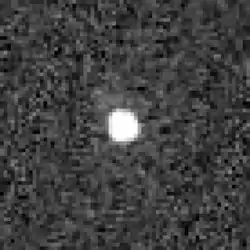
 Hubble Space Telescope image of 2006 QH181 taken in 2010 | |
| Discovery | |
|---|---|
| Discovered by | CTIO |
| Discovery date | 21 August 2006 |
| Designations | |
| 2006 QH181 | |
| Orbital characteristics[4] | |
| Epoch 13 January 2016 (JD 2457400.5)[4] | |
| Uncertainty parameter 6 | |
| Observation arc | 2634 days (7.21 yr) |
| Aphelion | 96.680 AU (14.4631 Tm) (Q) |
| Perihelion | 37.789 AU (5.6532 Tm) (q) |
| 67.235 AU (10.0582 Tm) (a) | |
| Eccentricity | 0.43795 (e) |
| 551.31 yr (201366 d) | |
| 102.28° (M) | |
| 0° 0m 6.436s / day (n) | |
| Inclination | 19.144° (i) |
| 73.840° (Ω) | |
| 211.02° (ω) | |
| Earth MOID | 36.7863 AU (5.50315 Tm) |
| Jupiter MOID | 32.6588 AU (4.88569 Tm) |
| Physical characteristics | |
| Dimensions | |
| 23.6[7] | |
| 4.3[4] | |
2006 QH181, also written as 2006 QH181, is a trans-Neptunian object (TNO) in the scattered disc.[2][3] Its orbit is currently too poorly determined (U=6)[4] to know whether it is in a resonance with Neptune.
Distance
It came to perihelion around 1858.[4] It is currently 83.8 AU from the Sun[7] and moving away from the Sun at 1.04 kilometers per second (2,300 miles per hour).[8] The only large objects currently farther from the Sun are Eris (96.1 AU),[9] 2014 UZ224 (90.9 AU), 2015 TH367 (~89 AU), Gonggong (88.0 AU),[10] Sedna (85.1 AU),[11] 2013 FS28 (84.8 AU), and 2014 FC69 (84.7 AU). Because it is so far from the Sun, it only has an apparent magnitude of 23.6.[7]
Orbit
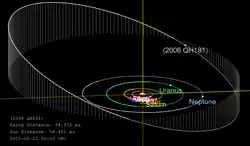
It has been observed 15 times over only three oppositions and thus currently has a somewhat poorly known orbit. JPL ranks orbital quality from 0 to 9 (0 being best), and 2006 QH181 is currently listed with an orbit quality of 6.[4][12]
See also
References
- ↑ "MPEC 2008-O05 : Distant Minor Planets". Minor Planet Center & Tamkin Foundation Computer Network. 17 July 2008. Retrieved 29 July 2008.
- 1 2 "List Of Centaurs and Scattered-Disk Objects". MPC. Retrieved 3 March 2007.
- 1 2 Marc W. Buie (5 March 2008). "Orbit Fit and Astrometric record for 06QH181". SwRI (Space Science Department). Retrieved 28 February 2014.
- 1 2 3 4 5 6 7 "JPL Small-Body Database Browser: (2006 QH181)" (last observation: 2013-11-06; arc: 7.21 years). Retrieved 30 March 2016.
- ↑ "Absolute Magnitude (H)". NASA/JPL. Archived from the original on 1 September 2008. Retrieved 29 July 2008.
- ↑ Wm. Robert Johnston. "List of Known Trans-Neptunian Objects". Johnston's Archive. Archived from the original on 18 February 2007. Retrieved 3 March 2007.
- 1 2 3 "AstDyS 2006QH181 Ephemerides". Department of Mathematics, University of Pisa, Italy. Retrieved 6 April 2014.
- ↑ "Horizon Online Ephemeris System". California Institute of Technology, Jet Propulsion Laboratory. Retrieved 22 January 2009.
- ↑ "AstDyS (136199) Eris Ephemerides". Department of Mathematics, University of Pisa, Italy. Retrieved 31 January 2012.
- ↑ "AstDyS 2007OR10 Ephemerides". Department of Mathematics, University of Pisa, Italy. Retrieved 31 January 2012.
- ↑ "AstDyS (90377) Sedna Ephemerides". Department of Mathematics, University of Pisa, Italy. Retrieved 31 January 2012.
- ↑ "2006 QH181". Minor Planet Center, IAU. Retrieved 5 February 2014.
External links
- 2006 QH181 at AstDyS-2, Asteroids—Dynamic Site
- 2006 QH181 at the JPL Small-Body Database
| |||||||
| Asteroid belt |
| _(cropped).jpg.webp)  | |||||
| Centaurs |
| ||||||
| Plutinos |
| ||||||
| Twotinos |
| ||||||
| Cubewanos and other Kuiper belt |
| ||||||
| Scattered disc | |||||||
| Detached objects |
| ||||||
| Sednoids |
| ||||||
| |||||||
