| Bambusa textilis | |
|---|---|
 | |
Scientific classification  | |
| Kingdom: | Plantae |
| Clade: | Tracheophytes |
| Clade: | Angiosperms |
| Clade: | Monocots |
| Clade: | Commelinids |
| Order: | Poales |
| Family: | Poaceae |
| Genus: | Bambusa |
| Species: | B. textilis |
| Binomial name | |
| Bambusa textilis | |
| Synonyms | |
|
Bambusa varioaurita W.T.Lin & Z.J.Feng | |
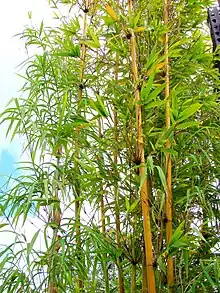
Bambusa textilis, also known as slender bamboo, clumping bamboo and weaver's bamboo, is a species of bamboo in the Poaceae (grasses) family that is native to China. The subspecies var. gracilis is heavily cultivated in Australia.[1]
Description
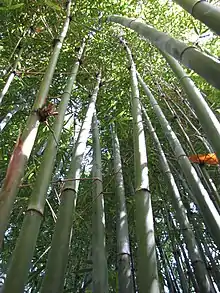
Slender bamboo is a giant, densely leaved, upright bamboo, that grows in a tight clump up to 6 to 10 meters high and 2 meters in width at a fast rate and has a stem size of 3cm.[2]
Having elegant leaves that are lanceolate shaped, 9-25 x 1-2.5 cm long, and greenish blue-hued culm that is glossy and leathery, its long green internodes, 35-60 cm, change to yellow during prolonged sunlight exposure. Despite being an evergreen, some leaf loss can be expected in winter, but this depends on the location and microclimate.[3]
The stalk and the rhizome are one, making it a non-invasive plant. The top part of the short rhizome has buds, one of which grows into another very truncated rhizome that then turns upward to surface from the ground as a subsidiary culm close to the parent.[4]
Distribution
In its native southern China, it usually found near rivers, on hills and villages at low altitudes in the Anhui, Guangdong, Fujian and Guangxi provinces.[5] It has been naturalized in Hawaii, Florida, Colombia and Puerto Rico.[6]
Cultivation
It is cultivated in particular to constitute hedges or privacy screens in suburban yards and can be planted in subtropical/tropical gardens where it can complement the native rainforest flora, and as well as in garden beds near a fence. It can also provide both noise and wind break, in addition to tolerating winds and temperatures as low as -10°C. Growing best in full sun to part shade, it may benefit from some mulch and nitrogen fertiliser.[7]
The variety var. gracilis is one of the most popular bamboos, especially in Australia, which is known as Gracilis bamboo, that forms a sightly slender clump and grows no more than 8 metres high. It reaches maturity within 3-5 years, depending on the weather and soil.[8] A gracilis in a 200mm container would usually grow to around 3 to 4 meters in 12 months. The glabra variety features more white on the lower areas of the internodes, giving the plant a striped appearance, and the fusca variety is larger, growing up to 12 meters and would top a 3 storey building.[9]
Varieties
- B. textilis var. fusca
- B. textilis var. glabra
- B. textilis var. gracilis
- B. textilis var. maculata
- B. textilis var. textilis
References
- ↑ Bambusa textilis var. gracilis Common Names: Gracilis, Slender Weavers Living Bamboo Production Nursery
- ↑ Rao, A.N., G. Dhanarajan, C.B. Sastry. 1985. Recent Research on Bamboos. Proceedings of the International Bamboo Workshop. October 6-14, 1985 1985, Hangzhou, People’s Republic of China. The Chinese Academy of Forestry, People’s Republic of China. International Development Research Centre, Canada
- ↑ Rao, A.N. and V. Ramanatha Rao, editors. 1998. Priority Species of Bamboo and Rattan. IPGRI-APO, Serdang, Malaysia.
- ↑ Bambusa textilis - McClure Plants for a Future
- ↑ Bambusa textilis McClure, Lingnan Univ. Sci. Bull. 9: 14. 1940. Flora of China
- ↑ Bambusa textilis Pacific Island Ecosystems at Risk (PIER)
- ↑ Bambusa textilis Gracilis Slender Weavers Bamboo Alpine Nurseries
- ↑ The best of clumping bamboo Better Homes and Gardens
- ↑ FUSCA THREE STOREY SCREENING BAMBOO Bamboo Down Under
Sources
- "Bambusa textilis McClure". Catalogue of Life. Species 2000: Leiden, the Netherlands.
- "Bambusa textilis". Flora of China – via eFloras.org, Missouri Botanical Garden, St. Louis, MO & Harvard University Herbaria, Cambridge, MA.
- "Bambusa textilis McClure (1940)". World Checklist of Selected Plant Families (WCSP). Royal Botanic Gardens, Kew.
- "Bambusa textilis McClure". World Checklist of Selected Plant Families. Royal Botanic Gardens, Kew – via The Plant List. Note that this website has been superseded by World Flora Online
- "Bambusa textilis McClure". Tropicos. Missouri Botanical Garden.
- "Bambusa textilis McClure, 1940". Universal Biological Indexer and Organizer (UBIO).
