| Bothriochloa | |
|---|---|
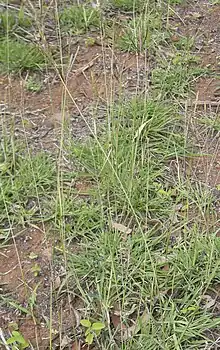 | |
| Bothriochloa pertusa | |
Scientific classification  | |
| Kingdom: | Plantae |
| Clade: | Tracheophytes |
| Clade: | Angiosperms |
| Clade: | Monocots |
| Clade: | Commelinids |
| Order: | Poales |
| Family: | Poaceae |
| Subfamily: | Panicoideae |
| Supertribe: | Andropogonodae |
| Tribe: | Andropogoneae |
| Subtribe: | Andropogoninae |
| Genus: | Bothriochloa Kuntze[1] |
| Type species | |
| Bothriochloa anamitica (syn of B. bladhii) | |
| Synonyms[2][3] | |
| |
Bothriochloa is a common and widespread genus of plants in the grass family native to many countries on all inhabited continents and many islands.[4] They are often called beardgrass, bluegrass or bluestem. Some species are invasive in areas where they have been introduced.[5][6]
The etymology of the genus name Bothriochloa derives from the two ancient Greek words βοθρίον (bothríon), meaning "small pit or trench", and χλόη or χλόα (khlóa), meaning "new green shoot or blade of grass".[7][8][9]
Shahid Nawaz, an agrostologist at the Blatter Herbarium, collected an interesting specimens of Bothriochloa from Gooty Fort Hill, Andhra Pradesh, India in December 2019.[10] The specimens were identified and confirmed as Bothriochloa ewartiana (Domin) C. E. Hubb. based on literature study and international correspondence with experts from Australia, Indonesia and Americas.[10] This study adds an extended and disjunct distribution of a Far Eastern species in Asia from India.[10]
Systematics
Species list
The following species are recognised:[3]
- Bothriochloa alta (Hitchc.) Henrard – tall beardgrass – Americas from New Mexico to Argentina
- Bothriochloa barbinodis (Lag.) Herter– cane bluestem – USA (CO MO OK AZ CA NV UT TX NM FL SC), Mexico, El Salvador, South America (from Colombia to Paraguay)
- Bothriochloa biloba S.T.Blake – Queensland, New South Wales
- Bothriochloa bladhii (Retz.) S.T.Blake – Asia (Yemen to Caucasus to Japan to Maluku), Australia, New Guinea, Africa, Madagascar
- Bothriochloa bunyensis B.K.Simon – Queensland
- Bothriochloa campii (Swallen) De Wet – Ecuador
- Bothriochloa compressa (Hook.f.) Henrard – India, Lesser Sunda Islands
- Bothriochloa decipiens (Hack.) C.E.Hubb. – Australia
- Bothriochloa edwardsiana (Gould) Parodi – Mexico, Texas, Argentina, Uruguay
- Bothriochloa ensiformis (Hook.f.) Henrard – India
- Bothriochloa erianthoides (F.Muell.) C.E.Hubb. – Queensland, New South Wales
- Bothriochloa eurylemma M.Marchi & Longhi – Wagner – Brazil (Mato Grosso do Sul), Argentina (Entre Ríos, Chaco, Formosa, Tucumán, Salta)
- Bothriochloa ewartiana (Domin) C.E.Hubb. – Australia, Philippines, Lesser Sunda Islands, Andhra Pradesh, India
- Bothriochloa exaristata (Nash) Henrard – awnless beardgrass – southern Brazil, northern Argentina, Paraguay, Bolivia, Peru, USA (TX LA)
- Bothriochloa grahamii (Haines) Bor – India
- Bothriochloa hirtifolia (J.Presl) Henrard – Mexico, Guatemala
- Bothriochloa hybrida (Gould) Gould – USA (TX LA), Mexico (from Chihuahua to Oaxaca)
- Bothriochloa imperatoides (Lillo) Herter – Rio Grande do Sul, northern Argentina, Uruguay
- Bothriochloa insculpta (Hochst. ex A.Rich.) A.Camus – sweetpitted grass – Africa, Madagascar, India, Arabian Peninsula, Spain, Sicily
- Bothriochloa ischaemum (L.) Keng – yellow bluestem – Eurasia + North Africa from Portugal + Canary Islands to Korea
- Bothriochloa kuntzeana (Hack.) Henrard – India, Nepal
- Bothriochloa laguroides (DC.) Herter – silver bluestem – Americas from Mexico to Chile
- Bothriochloa longifolia (Hack.) Bor – India
- Bothriochloa longipaniculata (Gould) Allred & Gould – longspike beardgrass – Brazil (Mato Grosso do Sul, Rio de Janeiro, Rio Grande do Sul, Santa Catarina), Argentina (Corrientes, Chaco, Formosa, Misiones), Paraguay, Guatemala, Mexico, USA (TX LA MS)
- Bothriochloa macra (Steud.) S.T.Blake – red – leg grass, red grass, redleg or pitted beard grass – Australia
- Bothriochloa meridionalis M.Marchi & Longhi – Wagner – Venezuela, Colombia, Ecuador, Rio Grande do Sul
- Bothriochloa modesta (Backer) Backer & Henrard – Java, Lesser Sunda Islands
- Bothriochloa pertusa (L.) A.Camus – pitted beardgrass – China, India, Southeast Asia, Australia, islands of Indian Ocean + western Pacific
- Bothriochloa pseudischaemum (Nees ex Steud.) Henrard – India, Sri Lanka
- Bothriochloa radicans (Lehm.) A.Camus – eastern + southern Africa, Arabian Peninsula
- Bothriochloa saccharoides Rydb. – Americas from Utah to Uruguay
- Bothriochloa springfieldii (Gould) Parodi – USA (CO AZ UT TX NM LA), Mexico, Bolivia, Argentina
- Bothriochloa torreyana (Steud.) Scrivanti & Anton – southern USA (from CA to SC), Mexico, Central America, Brazil, Argentina, Uruguay
- Bothriochloa velutina M.Marchi & Longhi – Wagner – Paraná, Santa Catarina
- Bothriochloa woodrovii (Hook.f.) A.Camus – India
- Bothriochloa wrightii (Hack.) Henrard – Mexico, USA (TX NM AZ)
Former taxa
See Capillipedium, Dichanthium, Euclasta, Hemisorghum and Pseudosorghum.
The following taxa were formerly included in the genus:[3]
- Bothriochloa assimilis – Capillipedium assimile
- Bothriochloa concanensis – Dichanthium concanense
- Bothriochloa foulkesii – Dichanthium foulkesii
- Bothriochloa gracilis – Pseudosorghum fasciculare
- Bothriochloa kwashotensis – Capillipedium kwashotense
- Bothriochloa parviflora – Capillipedium parviflorum
- Bothriochloa picta – Capillipedium assimile
- Bothriochloa piptanthera – Euclasta condylotricha
- Bothriochloa spicigera – Capillipedium spicigerum
- Bothriochloa tuberculata – Dichanthium annulatum
- Bothriochloa venusta – Hemisorghum venustum
- Bothriochloa yunnanensis – Pseudosorghum fasciculare
See also
References
- ↑ Kuntze, Carl Ernst Otto 1891. Revisio Generum Plantarum 2: 762 description in Latin, commentary in German
- 1 2 Tropicos, Bothriochloa Kuntze
- 1 2 3 Kew World Checklist of Selected Plant Families
- ↑ Watson L, Dallwitz MJ. (2008). "The grass genera of the world: descriptions, illustrations, identification, and information retrieval; including synonyms, morphology, anatomy, physiology, phytochemistry, cytology, classification, pathogens, world and local distribution, and references". The Grass Genera of the World. Retrieved 2009-08-19.
- ↑ Jepson Manual Treatment
- ↑ United States Department of Agriculture Plants Profile
- ↑ Bailly, Anatole (1981-01-01). Abrégé du dictionnaire grec français. Paris: Hachette. ISBN 978-2010035289. OCLC 461974285.
- ↑ Bailly, Anatole. "Greek-french dictionary online". www.tabularium.be. Retrieved October 8, 2020.
- ↑ Ellen Dorn, Native Plants of Arizona 2004, Bothriochloa barbinodis (Lag.) Herter
- 1 2 3 Landge, Shahid Nawaz; Shinde, Rajendra D. (20 August 2021). "Synopsis of the genus Bothriochloa (Poaceae: Andropogoneae) in India". Phytotaxa. 516 (1): 43–58. doi:10.11646/phytotaxa.516.1.3. S2CID 238722563 – via Magnolia Press.