| Campanula carpatica | |
|---|---|
 | |
Scientific classification  | |
| Kingdom: | Plantae |
| Clade: | Tracheophytes |
| Clade: | Angiosperms |
| Clade: | Eudicots |
| Clade: | Asterids |
| Order: | Asterales |
| Family: | Campanulaceae |
| Genus: | Campanula |
| Species: | C. carpatica |
| Binomial name | |
| Campanula carpatica | |
| Synonyms[1] | |
| |
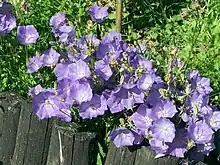
Campanula carpatica, the tussock bellflower[2][3] or Carpathian harebell, is a species of flowering plant in the family Campanulaceae.
Description
Campanula carpatica is a low-growing herbaceous perennial. Plants possess basal leaves and thin, white rhizomes. Stems grow up to 45cm long. Flowers are solitary and stand on stalks ranging from 10-15cm long. Flowers are purple in colour and plants bloom from June to August.[4]
Distribution
Native Range
Campanula carpatica is native to parts of Europe including the Czech Republic, Romania, Slovakia, Ukraine,[5] Poland and Western Russia.[4] It can also be found growing within the Carpathian Mountains of Central Europe.[5]
Introduced Range
Campanula carpatica has also been introduced into areas outside of its natural range. This species was introduced further into Europe in Hungary,[5] Denmark, Belgium, France, Norway and the United Kingdom.[6] The species was also introduced into North America where it has been recorded in the states of Connecticut and Michigan.[5]
Habitat
Campanula carpatica naturally grows in elevated, mountainous habitat where they grow in and amongst rocks.[4]
Cultivation
It was introduced to the Royal Botanic Garden at Kew in 1774 by Nikolaus Joseph von Jacquin.[7]
Several cultivars in shades of white, blue, pink and purple, have been developed for garden use.[8]
This plant has gained the Royal Horticultural Society's Award of Garden Merit.[9]
References
- ↑ "Campanula carpatica". Plants of the World Online. Royal Botanic Gardens, Kew. Retrieved 22 May 2022.
- ↑ BSBI List 2007 (xls). Botanical Society of Britain and Ireland. Archived from the original (xls) on 2015-06-26. Retrieved 2014-10-17.
- ↑ USDA, NRCS (n.d.). "Campanula carpatica". The PLANTS Database (plants.usda.gov). Greensboro, North Carolina: National Plant Data Team. Retrieved 10 January 2016.
- 1 2 3 Phillips, Rix, Roger, Martyn (1991). Perennials Volume 2 Late Perennials. Pan Books. p. 128. ISBN 0330292757.
{{cite book}}: CS1 maint: multiple names: authors list (link) - 1 2 3 4 "Campanula carpatica Jacq". powo.science.kew.org. 2022-05-22. Retrieved 2022-05-22.
- ↑ "Campanula carpatica Jacq". Global Biodiversity Information Facility. 2022-05-22. Retrieved 2022-05-22.
- ↑ William Curtis (1790). "The Botanical Magazine": 117.
{{cite journal}}: Cite journal requires|journal=(help) - ↑ RHS A-Z encyclopedia of garden plants. United Kingdom: Dorling Kindersley. 2008. p. 1136. ISBN 978-1405332965.
- ↑ "RHS Plant Selector - Campanula carpatica". Retrieved 15 April 2020.
