Native name: Kitsissut | |
|---|---|
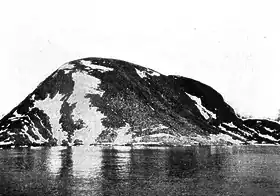 View of Björling Island | |
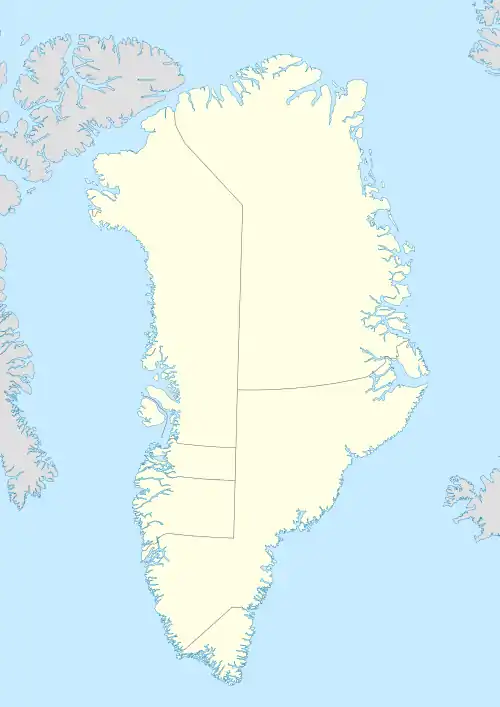  Carey Islands Carey Islands (Greenland) | |
| Geography | |
| Location | Baffin Bay, Greenland |
| Coordinates | 76°40′00″N 72°30′00″W / 76.666667°N 72.5°W |
| Archipelago | Carey Islands |
| Total islands | 6 |
| Major islands | Nordvestø |
| Highest elevation | 300 m (1000 ft) |
| Administration | |
Greenland | |
| Municipality | Avannaata |
| Demographics | |
| Population | uninhabited |

The Carey Islands (Danish: Carey Øer; Greenlandic: Kitsissut) are an island group off Baffin Bay, in Avannaata municipality, northwest Greenland. Located relatively far offshore the Carey Islands are the westernmost point of Greenland as a territory. The sea surrounding the islands is clogged by ice most of the year.
Geography
The archipelago consists of six desolate islands, a few small islets and a number of rocks awash.[1] It is located about 100 kilometres (62 mi) to the west of Thule Air Base and 50 kilometres (31 mi) to the SW of Cape Parry.[2]
The nearest settlement is Moriusaq to the east on the coast of Greenland, abandoned since 2007.
Islands
Main islands
- Nordvestø, Isbjørneø and Mellemø form a compact cluster at the NW end of the archipelago.
- Nordvestø, the biggest island with a length of 4.5 kilometres (2.8 mi) and a width of nearly 3 kilometres (1.9 mi). This island's western landhead is the westernmost point of Greenland. Its highest point is 225 metres (738 ft).
- Isbjørneø and Mellemø, lying close to the east and forming a natural harbour between them and Nordvestø.
- Bordø and Björlingø, located further to the east; the latter has a 300 metres (980 ft) high peak and is named after Johan Alfred Björling.
- Fireø, lying in the southern area of the group.
Islets
- Hollænderhatten and Tyreøjet are two small islets to the east of Fireø having a diameter of a few hundred metres. there are also numerous other islets and rocks, especially in the western sector of the archipelago.[3]
Important Bird Area
The island group has been designated an Important Bird Area (IBA) by BirdLife International because it supports a breeding population of some 6,700 pairs of thick-billed murres, as well as other seabirds including glaucous gulls, razorbills, black guillemots and Atlantic puffins.[4]
History
The islands had been inhabited by the Inuit in the past; remains of their dwellings were found by Clements Markham in August 1851.[5]
The Carey Islands' were named by the 1616 Bylot-Baffin Arctic expedition after Allwin Carey, one of the financiers of the venture.[6]
Swedish naturalists Alfred Björling and Evald Kallstenius stopped at the Carey Islands in 1892 during an expedition on schooner Ripple to pick up supplies at a cache there. The Ripple, however, was driven on shore and wrecked. The men attempted to sail a small sloop back to Etah, but were forced to return to the Carey Islands.[7]
According to letters left by members of the ill-fated expedition in a cairn on the islands, the remaining four men attempted to sail their open boat 80 miles to Ellesmere Island:
Forced by bad weather to linger on this island for a long time, I now set out on the tour to the Eskimos... on Ellesmere Island. As I hope that a whaler will visit the Carey Islands next summer to rescue me and my companions, I will try to reach the islands again before July 1. We are now five men, of which one is dying.[8]
In June 1893, the crew of the Scottish whaler Aurora spotted a wreck on the Carey Islands. They found the Ripple, a man's body buried under a pile of stones, and Björling's letters.[8] No trace of the other four men, or the small boat, was ever found.
See also
References
- ↑ "Carey Øer". Mapcarta. Retrieved 10 April 2016.
- ↑ Carey Islands, Greenland
- ↑ Sailing Directions (Enroute), Pub. 181: Greenland and Iceland (PDF). Sailing Directions. United States National Geospatial-Intelligence Agency. 2017. p. 70.
- ↑ "Carey Islands". BirdLife Data Zone. BirdLife International. 2021. Retrieved 28 November 2021.
- ↑ Clements Robert Markham: Franklin’s footsteps. Chapman and Hall, London 1853, p. 115.
- ↑ Thomas Rundall. Narratives of Voyages towards the North-west, in search of a Passage to Cathay and India, 1496 to 1631. The Hakluyt Society, London 1849, S. 141.
- ↑ Mowat, Farley (1967). The Polar Passion: The Quest for the North Pole. Toronto: McClelland and Stewart Limited.
- 1 2 Harper, Ken. (Oct 7, 2005) Nunatsiaq News: "Taissumani: A Day in Arctic History Oct. 12, 1892 - The Disappearance of Bjorling and Kallstenius"