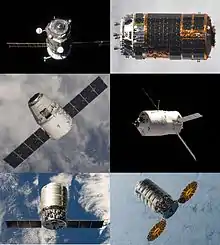
A collage of automated cargo spacecraft used in the past or present to resupply the International Space Station
A number of different spacecraft have been used to carry cargo to and from space stations.
Table code key
| Spacecraft under development | |
| Spacecraft is operational or inactive | |
| Retired or cancelled spacecraft | |
| § | Pressurized / Unpressurized payload capacity |
Orbital space vehicles
| Spacecraft | Origin | Manufacturer | Launch system | Length (m) | Dry mass (kg) | Launch mass (kg) | Payload (kg) § | Payload volume (m3) § | Return payload (kg) | Diameter (m) | Generated power (W) | Automated docking | Status (No. Flights) |
|---|---|---|---|---|---|---|---|---|---|---|---|---|---|
| TKS |  Soviet Union Soviet Union |
TsKBM | Proton-K | 17.51 | 13,688 | 21,620 | 12,600 | 4.15 | 2,400 | No | Retired (4) | ||
| Progress 7K-TG | Soviet Union |
Energia | Soyuz-U | None | No | Retired (43) | |||||||
| Progress-M 11F615A55 |
Soviet Union Russia Russia |
Energia | Soyuz-U Soyuz-U2 |
7.2 | 7,130 | 2,600 | 7.6 | 150[lower-alpha 1] | 2.72 | 600[1] | Yes | Retired (66) | |
| Progress-M1 |
Russia |
Energia | Soyuz-U Soyuz-FG |
None | Yes | Retired (11) | |||||||
| Progress-M 11F615A60 |
Russia |
Energia | Soyuz-U Soyuz-2.1a |
7.2 | 7,150 | 2,230 | 7.6 | None | 2.72 | 700 | Yes | Retired (27 + 2 failed) | |
| Cygnus (standard) |  USA USA |
Orbital | Antares 1x0 | 5.14 | 1,500[2] | 2,000[2] | 18.9[2] | None | 3.07 | 3,500[3] | No | Retired (3 + 1 failed) | |
| Dragon (reusable) | USA |
SpaceX | Falcon 9 | 6.1 | 4,200[4] | 10,200[lower-alpha 2] | 6,000[lower-alpha 3][5] | 10.0 / (14 or 34)[lower-alpha 4][6] | 3,000[lower-alpha 5][7] | 3.7 | 2,000[8] | No | Retired (19 + 1 failed)[9] |
| ATV |  Europe Europe |
EADS | Ariane 5ES | 10.3 | 10,470[10] | 20,750[10] | 7,667[10] | 48 | None | 4.5 | 3,800[11] | Yes | Retired (5) |
| HTV |  Japan Japan |
JAXA | H-IIB | 10 | 10,500[12] | 16,500[12] | 3,000 / 1,000[12] | 14 / 16[12] | 20[lower-alpha 6][13] | 4.4 | 200 | No | Retired (9) |
| Tianzhou (basic) |
 China China |
CAST | Long March 7 | 10.6 | 13,500 | 6,900[lower-alpha 7][14] | 18.1 | None | 3.35 | Yes | Retired (5) | ||
| Progress-MS | Russia |
Energia | Soyuz-U Soyuz-2.1a |
7.2 | 7,150 | 2,230 | None | Yes | Operational[15] | ||||
| Dragon 2 cargo (reusable) | USA |
SpaceX | Falcon 9 | 8.1 | 6,400 | 6,000[16] | 9.3 / 37 | 3,000[16] | 4.0 | Yes | Operational | ||
| Cygnus (enhanced) | USA |
Northrop Grumman | Antares 230 Antares 230+ Atlas V 401 Antares 330 Falcon 9 |
6.34 | 1,800[17] | 3,750 | 27[17] | None | 3.07 | No | Operational | ||
| Tianzhou (improved) | China |
CAST | Long March 7 | 10.6 | 14,000 | 7,400[lower-alpha 8][14] | 22.5 (~40 total) | None | 3.35 | Yes | Operational | ||
| Dream Chaser Cargo System (reusable) | USA |
Sierra Nevada Corporation | Vulcan Centaur | 5,000 / 500[18] | 1,750[18] | Yes | Development | ||||||
| HTV-X | Japan |
JAXA | H3 Launch Vehicle[19] | 10[lower-alpha 9] | 8,300 | 16,000, combined[20] | 4,069 / 1,750 | 78[lower-alpha 10] | 4.4 | 1,000 | No[lower-alpha 11] | Development[21] | |
| Cygnus (Mission B) | USA |
Northrop Grumman | Antares 330 | 5,000 | |||||||||
| Dragon XL | USA |
SpaceX | Falcon 9 | 5,000[22] | None | Yes[22] | Development[23] | ||||||
| Argo | Europe |
Rocket Factory Augsburg AG (RFA) | Launch Vehicle Ambiguous | 3,400 | <13 | Greater than or equal to 1 Ton [24] | Yes | Development[25] | |||||
| NYX | Europe |
The Exploration Company | Launch Vehicle Ambiguous | 4,000 | 2500 pressurized and 100 unpressurized[26] | Yes | Development[27] |

Notes
- ↑ With optional Raduga capsule.
- ↑ 4,200kg dry mass + 6,000kg up mass
- ↑ In any combination of pressurized or unpressurized.
- ↑ 34 unpressurized with extended trunk
- ↑ Capsule return.
- ↑ With optional HSRC.
- ↑ Including propellant.
- ↑ Including propellant.
- ↑ 10 with cargo module, 6.2 without.
- ↑ Combined.
- ↑ Technology trial of an automated IDSS docking port fitted in place of unpressurised cargo module being planned.
See also
References
- ↑ "Progress M". Archived from the original on 10 July 2009. Retrieved 29 May 2012.
- 1 2 3 "Cygnus Fast Sheet" (PDF). Orbital Sciences Co. Retrieved 7 August 2013.
- ↑ "The Annual Compendium of Commercial Space Transportation: 2012" (PDF). Federal Aviation Administration. February 2012. Retrieved 8 February 2013.
- ↑ "SpaceX Brochure v7" (PDF). Archived from the original (PDF) on 20 March 2012. Retrieved 29 May 2012.
- ↑ Bergin, Chris (19 October 2012). "Dragon enjoying ISS stay, despite minor issues – Falcon 9 investigation begins". NASASpaceflight.com. Retrieved 21 October 2012.
CRS-2 will debut the use of Dragon's Trunk section, capable of delivering unpressurized cargo, prior to the payload being removed by the ISS' robotic assets after berthing.
- ↑ "Overall Dragon Capabilities" (PDF). Archived from the original (PDF) on 2011-01-04. Retrieved 2016-07-21.
- ↑ "Falcon 9 launches Dragon on CRS-1 mission to the ISS". 7 October 2012.
- ↑ "Dragonlab Datasheet" (PDF). Archived from the original (PDF) on 4 January 2011. Retrieved 29 May 2012.
- ↑ Clark, Stephen. "With successful splashdown, SpaceX retires first version of Dragon spacecraft – Spaceflight Now". Retrieved 2020-04-10.
- 1 2 3 "ESA Automated Transfer Vehicle". ESA. Retrieved 7 August 2013.
- ↑ "ATV Utilization Relevant Data" (PDF). Retrieved 29 May 2012.
- 1 2 3 4 "JAXA transition examination of the new space station supply machine (HTV-X)" (PDF). JAXA. Retrieved 6 February 2018.
- ↑ "HTV 搭載小型回収カプセルの開発" (PDF) (in Japanese). Japan Aerospace Exploration Agency. 12 November 2014. Retrieved 2016-10-21.
- 1 2 Jones, Andrew (10 May 2023). "Tianzhou-6 cargo spacecraft reaches China's Tiangong space station". spacenews.com. Retrieved 10 May 2023.
- ↑ "Upgraded Progress MS docks with the ISS". NASASpaceflight.com. 23 December 2015. Retrieved 26 December 2015.
- 1 2 "Dragon". SpaceX. Archived from the original on 2 March 2019. Retrieved 11 April 2020.
- 1 2 "Cygnus Spacecraft Information". Spaceflight101. Archived from the original on 2015-09-09.
- 1 2 "Sierra Nevada Hopes Dream Chaser Finds "Sweet Spot" of ISS Cargo Competition". SpaceNews. 18 March 2015. Retrieved 20 February 2016.
- ↑ "H3,H-IIA/Bのミッション割当て(案)" (PDF) (in Japanese). MEXT. 8 March 2016. Retrieved 2016-03-10.
- ↑ "HTV-X, the new unmanned spacecraft now being developed by JAXA". JAXA. Retrieved November 23, 2022.
- ↑ Funding for HTV-X development was included in the FY 2016 JAXA budget
- 1 2 "NASA picks SpaceX to deliver cargo to Gateway station in lunar orbit – Spaceflight Now". Retrieved 2023-06-07.
- ↑ Foust, Jeff (2023-02-24). "NASA plans to start work this year on first Gateway logistics mission". SpaceNews. Retrieved 2023-06-07.
- ↑ Parsonson, Andrew (20 September 2023). "RFA-Led Consortium Submit Argo for ESA Commercial Cargo Initiative". European Spaceflight. Retrieved 22 September 2023.
- ↑ Rocket Factory Augsburg. "One (c)argo capsule, tons of possibilities!". Twitter. Retrieved 21 September 2023.
- ↑ Parsonson, Andrew (23 February 2022). "The Exploration Company aims to offer Europe independent access to space". European Spaceflight. Retrieved 22 September 2023.
- ↑ The Exploration Company. "Missions". Retrieved 22 September 2023.
| Active | 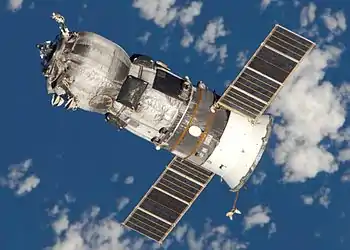 | |
|---|---|---|
| In development | ||
| Retired | ||
| Proposed | ||
| Cancelled | ||
This article is issued from Wikipedia. The text is licensed under Creative Commons - Attribution - Sharealike. Additional terms may apply for the media files.