In mathematics, particularly in operator theory and C*-algebra theory, a continuous functional calculus is a functional calculus which allows the application of a continuous function to normal elements of a C*-algebra.
Theorem
Theorem. Let x be a normal element of a C*-algebra A with an identity element e. Let C be the C*-algebra of the bounded continuous functions on the spectrum σ(x) of x. Then there exists a unique mapping π : C → A, where π(f) is denoted f(x), such that π is a unit-preserving morphism of C*-algebras and π(1) = e and π(id) = x, where id denotes the function z → z on σ(x).[1]
In particular, this theorem implies that bounded normal operators on a Hilbert space have a continuous functional calculus. Its proof is almost immediate from the Gelfand representation: it suffices to assume A is the C*-algebra of continuous functions on some compact space X and define
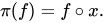
Uniqueness follows from application of the Stone–Weierstrass theorem. Furthermore, the spectral mapping theorem holds:

See also
References
- ↑ Theorem VII.1 p. 222 in Modern methods of mathematical physics, Vol. 1, Reed M., Simon B.
External links
| Spaces |
| ||||
|---|---|---|---|---|---|
| Theorems | |||||
| Operators | |||||
| Algebras | |||||
| Open problems | |||||
| Applications | |||||
| Advanced topics | |||||
| |||||