| Cuphea viscosissima | |
|---|---|
 | |
Scientific classification  | |
| Kingdom: | Plantae |
| Clade: | Tracheophytes |
| Clade: | Angiosperms |
| Clade: | Eudicots |
| Clade: | Rosids |
| Order: | Myrtales |
| Family: | Lythraceae |
| Genus: | Cuphea |
| Species: | C. viscosissima |
| Binomial name | |
| Cuphea viscosissima | |
| Synonyms[1][2] | |
| |

Wikispecies has information related to Cuphea viscosissima.
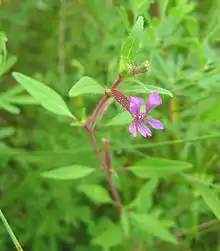
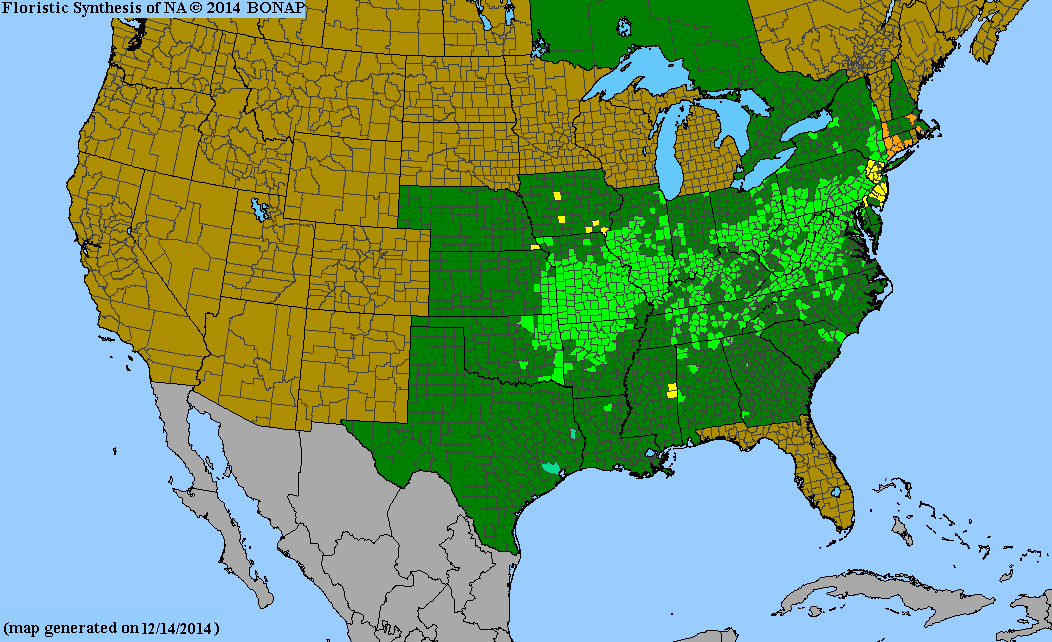
Cuphea viscosissima, also known as blue waxweed,[3][4] clammy cuphea or (ambiguously) as "tarweed",[1][5] is an herbaceous plant in the loosestrife family. It native to the eastern United States,[6] where it is most often found in open, rocky calcareous areas.[7][8] It is the most common and widespread Cuphea in the U.S.[9]
This species is notable for its sticky stems. It produces a purple-red flower in late summer.[10] Flowers attract butterflies and hummingbirds.[8]
This species is morphological similar to Cuphea lanceolata, which is found in Mexico. It can be distinguished from Cuphea lanceolata by its smaller flower.[9]
References
- 1 2 "Cuphea viscosissima". Germplasm Resources Information Network. Agricultural Research Service, United States Department of Agriculture. Retrieved January 19, 2018.
- ↑ "Cuphea viscosissima". Integrated Taxonomic Information System. Retrieved October 25, 2007.
- ↑ Blanchan, Neltje (2002). Wild Flowers: An Aid to Knowledge of our Wild Flowers and their Insect Visitors. Project Gutenberg Literary Archive Foundation.
- ↑ Cuphea viscosissima at USDA PLANTS Database
- ↑ Cuphea viscosissima at Plants For A Future
- ↑ "Cuphea viscosissima". County-level distribution map from the North American Plant Atlas (NAPA). Biota of North America Program (BONAP). 2014. Retrieved 20 January 2017.
- ↑ "Flora of the Southern and Mid-Atlantic States". Archived from the original on 2018-10-06. Retrieved 2017-01-21.
- 1 2 Missouri Botanical Garden
- 1 2 Graham, Shirley (1988). "Revision of Cuphea Section Heterodon (Lythraceae)". Systematic Botany Monographs. 20: 1–168. doi:10.2307/25027697. JSTOR 25027697.
- ↑ "Missouri Plants". Archived from the original on 2015-08-31. Retrieved 2017-01-21.
This article is issued from Wikipedia. The text is licensed under Creative Commons - Attribution - Sharealike. Additional terms may apply for the media files.