| Gempylidae | |
|---|---|
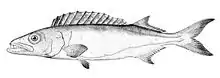 | |
| Oilfish, Ruvettus pretiosus | |
Scientific classification  | |
| Domain: | Eukaryota |
| Kingdom: | Animalia |
| Phylum: | Chordata |
| Class: | Actinopterygii |
| Order: | Scombriformes |
| Suborder: | Scombroidei |
| Family: | Gempylidae T. N. Gill, 1862 |
| Genera[1] | |
The Gempylidae are a family of perciform fishes commonly known as snake mackerels or escolars. The family includes about 25 species.
They are elongated fishes with a similar appearance to barracudas, having a long dorsal fin, usually with one or finlets trailing it. The largest species, including the snoek (Thyrsites atun), grow up to 2 m long, and the oilfish (Ruvettus pretiosus) can reach 3 m, though they rarely surpass 150 cm. Like the barracudas, they are predators, with fang-like teeth.[2]
They are deep-water benthopelagic fishes, and several species are important commercial and game fishes.
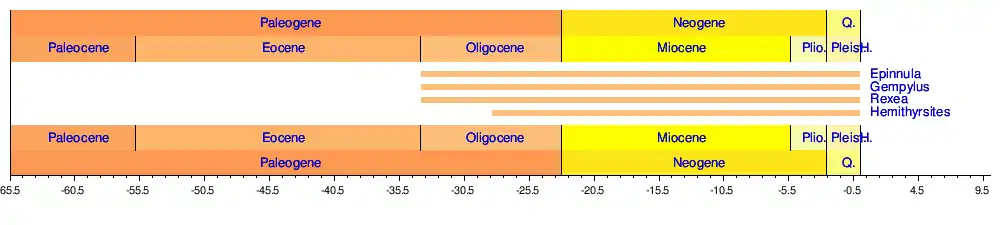
Timeline
See also
- Euzaphlegidae, an extinct group of relatives from Paleocene to Late Miocene-aged marine strata of Europe, the Caucasus Mountains,[3] India, Iran, Turkmenistan, Italy,[4] and Southern California.[5]
References
- ↑ Froese, Rainer, and Daniel Pauly, eds. (2013). "Gempylidae" in FishBase. April 2013 version.
- ↑ Johnson, G.D.; Gill, A.C. (1998). Paxton, J.R.; Eschmeyer, W.N. (eds.). Encyclopedia of Fishes. San Diego: Academic Press. p. 190. ISBN 0-12-547665-5.
- ↑ Danilʹchenko, P. G. (1967). Bony fishes of the Maikop deposits of the Caucasus.
- ↑ Bannikov, Alexandre F. (2008). "A new genus and species of putative euzaphlegid fish from the Eocene of Bolca in norther Italy (Periformes, Trichiuroidea)." Studi e Ricerche sui giacimenti Terziari di Bolca, XII Miscellanea Paleontologica 9: 99-107.
- ↑ David, Lore Rose (January 10, 1943). Miocene Fishes of Southern California. Geological Society of America. pp. 104-115.
External links

Wikimedia Commons has media related to Gempylidae.
- Sepkoski, Jack (2002). "A compendium of fossil marine animal genera". Bulletins of American Paleontology. 364: 560. Archived from the original on July 23, 2011. Retrieved 2011-05-19.
- Scientia Marina - Population biology of the roudi escolar Promethichthys prometheus (Gempylidae) off the Canary Islands
- Deep water fish species - Lanzarote
This article is issued from Wikipedia. The text is licensed under Creative Commons - Attribution - Sharealike. Additional terms may apply for the media files.