George Finch-Hatton | |
|---|---|
.png.webp) | |
| Born | 30 June 1747 |
| Died | 17 February 1823 (aged 75) |
| Nationality | British |
| Education | Westminster School Christ's College, Cambridge (MA, 1768) |
| Occupation | Politician |
| Spouse | |
| Children |
|
| Parents |
|
| Relatives | Anne Hatton (Grandmother) Daniel Finch, 7th Earl of Winchilsea (Grandfather) |
George Finch-Hatton FRS (30 June 1747 – 17 February 1823)[1] was an English politician who sat in the House of Commons from 1772 to 1784.
Early life
Finch-Hatton was born on 30 June 1747 and the son of Hon. Edward Finch-Hatton, youngest son of Daniel Finch, 7th Earl of Winchilsea and 2nd Earl of Nottingham, and his wife Anne Palmer, daughter of Sir Thomas Palmer, 4th Baronet, of Wingham.[2] He was educated at Westminster School and at Christ's College, Cambridge, being awarded a Master of Arts degree in 1768. He assumed the additional surname of Hatton (his paternal grandmother's name) together with his father in 1764.[3]
He succeeded his uncle Daniel Finch, 8th Earl of Winchilsea to Eastwell Park and various Kentish properties in 1769 and his father to Kirby Hall, Northamptonshire in 1771.
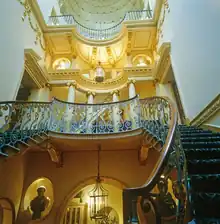
He also inherited 44 Berkeley Square (now Clermont Club), his aunt Lady Isabella Finch's incredible London home, which somehow went to his father Edward, in turned went to him since his father only survive his sister by a few months. In 1774, George sold it to Lord Clermont, an acquaintance of his late aunt and Princess Amelia, hence the house was again visited by Princess Amelia.[4]
In the same year 1774, George now had surplus from the sale of the house, commissioned Robert Adam to rebuilt Eastwell Park, but each of the designs were declined and eventually when on hold.[5]
George eventually rebuilt the house at Eastwell between 1793 and 1800 to designs by Robert Adam's former draughtsman Joseph Bonomi in Neo-classical style.[6]
Career
Finch-Hatton was elected Member of Parliament for Rochester at a by-election in 1772. He was re-elected to Rochester in contests in 1774 and 1780 but was defeated in at the 1784 general election.[2]
Finch-Hatton was elected a Fellow of the Royal Society in 1776.[7]
In 1809 he was commissioned as Lieutenant-Colonel Commandant of the Ashford Regiment of Local Militia (later the 1st East Kent or Ashford, Oldcastle and Elham Regiment).[8]
Personal life
.jpg.webp)
Finch-Hatton married Lady Elizabeth Murray (1760–1825), the daughter of David Murray, 2nd Earl of Mansfield (1747–1796), in 1785. They resided at Eastwell Park, Kent. He also had another estate, Kirby Hall, Northamptonshire.[3]
George and Lady Elizabeth had 7 children :
- Lady Louisa Anne m. Hon. Charles Hope, son of 2nd Earl of Hopetoun.
- Anna Maria (d.1838)
- Elizabeth Henrietta (d.1820)
- George Finch-Hatton, 10th Earl of Winchilsea, had issue 11th Earl of Winchilsea.
- Edward Frederick, Lieut.(d.1813)
- Hon. Rev. Daniel Heneage m. Lady Louisa Greville, daughter of 2nd Countess of Mansfield.
- Lady Emily Mary m. Alfred Charnley Lawrence, had issue.
Later in 1841, Queen Victoria granted all George and Elizabeth's children the style and precedence of the son/daughter of an earl by royal warrant, as if George had outlived his first cousin and became Earl of Winchilsea.[9]
%22.jpg.webp)
Jane Austen visited George and Lady Elizabeth at Eastwell Park numerous times, they were neighbors as Jane Austen's older brother, Edward Austen Knight resided at Godmersham Park four miles away. George was 1st cousin once removed to Elizabeth Bridges, wife of Edward Austen Knight. In her letters to her sister Cassandra, Austen seemed to have feelings for George's younger Brother, Edward Finch-Hatton.
"Eastwell was very agreeable; I found Ly. Gordon’s manners as pleasing as they had been described, and saw nothing to dislike in Sir Janison, excepting once or twice a sort of sneer at Mrs Anne Finch. . . [The Misses Finch] were very civil to me, as they always are; fortune was also very civil to me in placing Mr E. Hatton by me at dinner."[10]
Finch-Hatton died in February 1823 at the age of 75. His wife died in June 1825, aged 65. Their eldest son George William Finch-Hatton succeeded in the Earldoms of Winchilsea and Nottingham in 1826.
References
- ↑ The Register of Births & Baptisms in the Parish of St James within the Liberty of Westminster Vol. IV. 1741-1760. 20 July 1747.
- 1 2 "FINCH HATTON, George (1747-1823), of Eastwell Park, nr. Ashford, Kent". History of Parliament Online. Retrieved 28 October 2017.
- 1 2 "Finch-Hatton, George (FNC764G)". A Cambridge Alumni Database. University of Cambridge.
- ↑ Learmouth, Juliet (2016). The London Town House of Lady Isabella Finch. University of London (Courtauld Institute of Art).
- ↑ "Eastwell Park, Boughton Leeds, Kent: unexecuted alternative schemes for rebuilding the house for George Finch Hatton, 1774 (14)". collections.soane.org. Retrieved 26 April 2023.
- ↑ "Eastwell Park, Boughton Leeds, Kent: unexecuted alternative schemes for rebuilding the house for George Finch Hatton, 1774 (14)". collections.soane.org. Retrieved 26 April 2023.
- ↑ "Fellows details". Royal Society. Retrieved 23 January 2017.
- ↑ London Gazette 13 May 1809, p. 680.
- ↑ The London Gazette: The Appointed Organ for All Announcements of the Executive. 1841,7/12. H.M. Stationery Office. 1841.
- ↑ "Jane Austen's Letters: Letter 45, Sat 24 August 1805, from Godmersham: swapping as a sister sunk in poverty". Reveries Under the Sign of Austen, Two. 25 September 2011. Retrieved 13 January 2023.