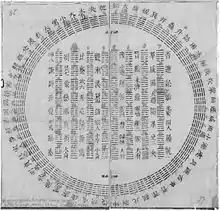
The hexagrams of the I Ching in a diagram belonging to the German mathematician philosopher Gottfried Wilhelm Leibniz[1]

The I Ching book consists of 64 hexagrams.[2] [3] A hexagram in this context is a figure composed of six stacked horizontal lines (爻 yáo), where each line is either Yang (an unbroken, or solid line), or Yin (broken, an open line with a gap in the center). The hexagram lines are traditionally counted from the bottom up, so the lowest line is considered line one while the top line is line six. Hexagrams are formed by combining the original eight trigrams in different combinations. Each hexagram is accompanied with a description, often cryptic, akin to parables. Each line in every hexagram is also given a similar description.

The Chinese word for a hexagram is 卦 "guà", although that also means trigram.

Types

Hexagram numbers, in King Wen sequence

Classic and modern I Ching commentaries mention a number of different hexagram types:

  • Eight Trigrams
  • Original Hexagram
  • Future Hexagram
  • Contrasting (Reverse) Hexagram (is found by turning a hexagram upside down)[4]
  • Complementary Hexagram (is found by changing all the lines into their opposite)[4]
  • Hexagram of Sequence[4]
  • Nuclear (Mutual) Hexagram (hu gua) (is found by taking the inner lines of a hexagram; given that the original hexagram's lines are labeled 1 through 6 from bottom up, the nuclear hexagram contains the lines 2, 3, 4, 3, 4, 5)[4]
  • Hexagram of Change (bian gua)
  • Internal Hexagram (nei gua)
  • External Hexagram (wai gua)

Sequences

The most commonly known sequence is the King Wen sequence. A totally different sequence was found in the Mawangdui Silk Texts. The hexagrams are also found in the Binary sequence, also known as Fu Xi sequence or Shao Yong sequence.

Lookup table

Upper →
Lower ↓
☰ ☱ ☲ ☳ ☴ ☵ ☶ ☷
乾(qián) 兌(duì) 離(lí) 震(zhèn) 巽(xùn) 坎(kǎn) 艮(gèn) 坤(kūn)
Heaven Lake Flame Thunder Wind Water Mountain Earth
☰ 1 43 14 34 9 5 26 11
䷀ ䷪ ䷍ ䷡ ䷈ ䷄ ䷙ ䷊
乾(qián) 乾(qián) 夬(guài) 大有(dàyǒu) 大壯(dàzhuàng) 小畜(xiǎoxù) 需(xū) 大畜(dàchù) 泰(tài)
Heaven Force Displacement Great Possessing Great Invigorating Small Harvest Attending Great Accumulating Pervading
☱ 10 58 38 54 61 60 41 19
䷉ ䷹ ䷥ ䷵ ䷼ ䷻ ䷨ ䷒
兌(duì) 履(lǚ) 兌(duì) 睽(kuí) 歸妹(guīmèi) 中孚(zhōngfú) 節(jié) 損(sǔn) 臨(lín)
Lake Treading Open Polarising Converting the Maiden Inner Truth Articulating Diminishing Nearing
☲ 13 49 30 55 37 63 22 36
䷌ ䷰ ䷝ ䷶ ䷤ ䷾ ䷕ ䷣
離(lí) 同人(tóngrén) 革(gé) 離(lí) 豐(fēng) 家人(jiārén) 既濟(jìjì) 賁(bì) 明夷(míngyí)
Flame Concording People Skinning Radiance Abounding Dwelling People Already Fording Adorning Intelligence Hidden
☳ 25 17 21 51 42 3 27 24
䷘ ䷐ ䷔ ䷲ ䷩ ䷂ ䷚ ䷗
震(zhèn) 無妄(wúwàng) 隨(suí) 噬嗑(shìhé) 震(zhèn) 益(yì) 屯(tún) 頤(yí) 復(fù)
Thunder Innocence Following Gnawing Bite Shake Augmenting Sprouting Swallowing Returning
☴ 44 28 50 32 57 48 18 46
䷫ ䷛ ䷱ ䷟ ䷸ ䷯ ䷑ ䷭
巽(xùn) 姤(gòu) 大過(dàguò) 鼎(dǐng) 恆(héng) 巽(xùn) 井(jǐng) 蠱(gǔ) 升(shēng)
Wind Coupling Great Exceeding Holding Persevering Ground Welling Correcting Ascending
☵ 6 47 64 40 59 29 4 7
䷅ ䷮ ䷿ ䷧ ䷺ ䷜ ䷃ ䷆
坎(kǎn) 訟(sòng) 困(kùn) 未濟(wèijì) 解(jiě) 渙(huàn) 坎(kǎn) 蒙(méng) 師(shī)
Water Arguing Confining Before Completion Deliverance Dispersing Gorge Enveloping Leading
☶ 33 31 56 62 53 39 52 15
䷠ ䷞ ䷷ ䷽ ䷴ ䷦ ䷳ ䷎
艮(gèn) 遯(dùn) 咸(xián) 旅(lǚ) 小過(xiǎoguò) 漸(jiàn) 蹇(jiǎn) 艮(gèn) 謙(qiān)
Mountain Retiring Conjoining Sojourning Small Exceeding Infiltrating Limping Bound Humbling
☷ 12 45 35 16 20 8 23 2
䷋ ䷬ ䷢ ䷏ ䷓ ䷇ ䷖ ䷁
坤(kūn) 否(pǐ) 萃(cuì) 晉(jìn) 豫(yù) 觀(guàn) 比(bǐ) 剝(bāo) 坤(kūn)
Earth Obstruction Clustering Prospering Providing-For Viewing Grouping Stripping Field

See also

References

  1. ↑ Perkins, Franklin. Leibniz and China: A Commerce of Light. Cambridge: Cambridge University Press, 2004. p 117. Print.
  2. ↑ Wilhelm, Richard (1950). The I Ching or Book of Changes.
  3. ↑ Legge, James (1964). I Ching: Book of Changes.
  4. 1 2 3 4 "Hexagrams of context". I Ching with Clarity.
This article is issued from Wikipedia. The text is licensed under Creative Commons - Attribution - Sharealike. Additional terms may apply for the media files.