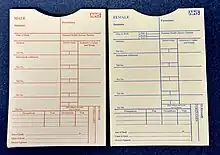
Lloyd George envelopes, named for British former Prime Minister David Lloyd George, are paper medical records used by general practitioners in the United Kingdom throughout most of the twentieth-century. They were produced using beige coloured card, with red parameters for males and blue for females. Each measures 130 mm × 180 mm and has provision for additional inserts.
Lloyd George cards were first used for workers who paid into National Health Insurance, a scheme introduced following the National Insurance Act 1911. The envelopes were introduced during the First World War and continued in use following the formation of the National Health Service (NHS) in 1948.
Lloyd George records provided an easy to visualise summary, prevented unnecessary lengthy note making, and could be carried in the doctor's coat pocket when out on a home visit. However, limited writing space resulted in brief inconsistent record keeping, and encouraged ineligible handwriting.
From the 1950s, as record keeping became more detailed and hospital interventions resulted in more correspondances, the relatively small Lloyd George envelopes became increasingly bulky. They were phased out in the late twentieth century and replaced to some extent with A4 folders, and eventually digitised with the adoption of computerised medical records.
Origin
.jpg.webp)
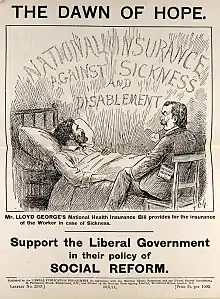
British former Prime Minister David Lloyd George, introduced a card to record medical information for low-income male workers who paid into National Health Insurance, a scheme introduced following the National Insurance Act 1911, when he was Chancellor of the Exchequer.[1][2] Between 1911 and the formation of the NHS in 1948, the record keeping cards were in general use by health boards and private general practitioners.[2] The envelopes were introduced during the First World War.[3] Their size was based on the large number of available ammunition boxes during the First World War.[4][5]
Design and usage
Lloyd George envelopes were made of beige coloured card and measure 130 mm × 180 mm.[2][6] They were produced with blue writing for females and red for males.[2] The record starts from birth and upon registration with a general practitioner.[7] There was one for everyone in the population.[7] Owned by the Secretary of State for Health, the Lloyd George record is transferred to GP practices as patients move, and hence contain a person's lifelong health record.[8][9] Inserted continuation cards have the date of printing in the bottom right hand corner.[10] The notes generally served as an aide-mémoire.[11]
The Lloyd George record had a certain sense of privacy, with notes tucked away in a wallet, unlike being visible on a computer screen.[12] Their small size was seen by some as "easy to handle".[5] They provided an easy to visualise summary, prevented unnecessary lengthy note making and could be carried in the doctor's coat pocket when out on a home visit.[5]
Limitations
Recorded detail varied between physicians, and ranged from documenting every illness to omitting major surgical procedures.[2] Not all doctors utilised the inserted summary card, until after 1990 and financial incentives to treat some longterm conditions such as asthma and diabetes.[2]
The limited space to document details reflected to some extent the type of medicine practiced in the early twentieth century.[2] People's expectations, limited medical knowledge, short consultation times, and limited medical tests, give consideration to the brief notes that were made by general practitioners.[2] The compact record discouraged detail and encouraged ineligible handwriting.[2] In addition it led to using acronyms such as "FLK" for "funny looking kid", and "TATT" for "tired all the time".[2] Recording treatment of a Strep throat would be shortened to "ST.Pen", without any elaboration on the person's history, examination findings or drug dose.[2]
Discontinuation
In the latter part of the twentieth century, as record keeping became more detailed and hospital interventions resulted in more documentations, the Lloyd George envelopes became increasingly bulky.[2] Whether hospital letters should be inserted into the envelopes folded with the writing on the inside for confidentiality, or outside for easy visibility, was just one matter for debate.[2] For people with longterm conditions, the envelopes became full, frequently requiring joining envelopes together, which was typically done using sellotape or rubber bands.[2] In 1974, a recommendation to replace the small envelopes with larger A4 folders, came from a joint working party of the Health Departments for England, Wales and Scotland, health authorities and general practitioners.[13] They were phased out in the late twentieth century and mostly replaced with A4 folders, and eventually digitised with the adoption of computerised medical records.[2] As of January 2021, no further Lloyd George envelopes are produced or distributed.[14][15]
References
- ↑ "Topics of the day". Coventry Evening Telegraph. 8 October 1912. p. 2.
- 1 2 3 4 5 6 7 8 9 10 11 12 13 14 15 Sherifi, James (2022). "5. Information management and technology". General Practice Under the NHS: Past, Present and Future. CRC Press. pp. 57–60. ISBN 978-1-000-62557-8.
- ↑ Sullivan, Frank (May 2016). "Atomic data: James Mackenzie Lecture 2015". The British Journal of General Practice. 66 (646): e368–e370. doi:10.3399/bjgp16X685153. ISSN 0960-1643. PMC 4838451. PMID 27127292.
- ↑ Neary, Joe (2003). "13. Achievements in record keeping: the use of information management and technology". In Lakhani, Mayur (ed.). A Celebration of General Practice. Abingdon: Radcliffe Publishing. p. 155. ISBN 978-1-85775-923-5.
- 1 2 3 Floyd, CB; White, DH (January 1986). "A medical record folder for the Lloyd George envelope" (PDF). The Journal of the Royal College of General Practitioners. 36 (282): 19–20. PMID 3701688.
- ↑ Collins, Kenneth E. (2023). Patient and Staff Voices in Primary Care: Learning from Dr Ockrim and her Glasgow Medical Practice. Boca Raton: CRC Press. p. 38. ISBN 978-1-032-43901-3.
- 1 2 Smith, Jack (1999). Health Management Information Systems: A Handbook for Decision Makers. McGraw-Hill Education (UK). p. 272. ISBN 978-0-335-20565-3.
- ↑ Morrell, David (1998). "Introduction and overview". In Loudon, Irvine; Horder, John; Webster, Charles (eds.). General Practice Under the National Health Service 1948-1997. Oxford: Clarendon Press. p. 10. ISBN 0-19-820675-5.
- ↑ Starey, Nigel (2003). The Challenge for Primary Care. Radcliffe Publishing. ISBN 978-1-85775-569-5.
- ↑ Buchan, Andrew; Lewis, Charles James (2012). Lewis and Buchan: Clinical Negligence: A Practical Guide. Bloomsbury Publishing. p. 468. ISBN 978-1-84766-673-4.
- ↑ Moreton, Philippa (1999). The Very Stuff of General Practice. Radcliffe Publishing. p. 122. ISBN 978-1-85775-390-5.
- ↑ Orme-Smith, Anne; Spicer, John (2018). Ethics in General Practice: A Practical Handbook for Personal Development. CRC Press. p. 42. ISBN 978-1-315-34851-3.
- ↑ "Written Answers To Questions". Hansard.parliament. 19 January 1988. Retrieved 26 November 2023.
- ↑ "Lloyd George envelopes & paper records | PCSE". pcse.england.nhs.uk. Retrieved 26 November 2023.
- ↑ "Lloyd George envelope". People's History of the NHS. 30 June 2017. Retrieved 26 November 2023.
Further reading
- "1948–1957: Establishing the National Health Service". Nuffield Trust. Retrieved 3 December 2023.