| Mamenchisauridae Temporal range: Possible Albian record | |
|---|---|
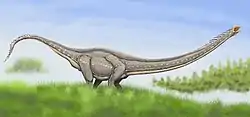 | |
| Mamenchisaurus | |
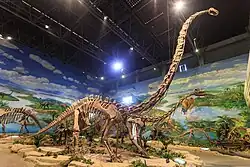 | |
| Skeleton of Mamenchisaurus hochuanensis | |
Scientific classification  | |
| Domain: | Eukaryota |
| Kingdom: | Animalia |
| Phylum: | Chordata |
| Clade: | Dinosauria |
| Clade: | Saurischia |
| Clade: | †Sauropodomorpha |
| Clade: | †Sauropoda |
| Clade: | †Eusauropoda |
| Family: | †Mamenchisauridae Young and Zhao, 1972 |
| Genera | |
| |
| Synonyms | |
| |
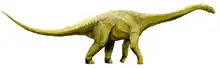
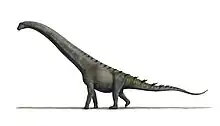
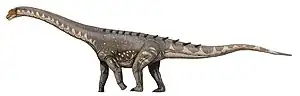
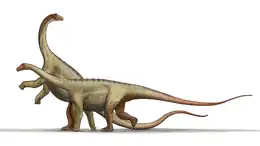
Mamenchisauridae is a family of sauropod dinosaurs belonging to Eusauropoda known from the Jurassic and Early Cretaceous of Asia and Africa. Some members of the group reached gigantic sizes, amongst the largest of all sauropods.[1]
Classification
The family Mamenchisauridae was first erected by Chinese paleontologists Yang Zhongjian ("C.C. Young") and Zhao Xijin in 1972, in a paper describing Mamenchisaurus hochuanensis.[2]
The most complete cladogram of Mamenchisauridae is presented by Moore et al., 2020, which includes several named species. Notably, some iterations of their analysis recover Euhelopus and kin, usually considered somphospondylians, as relatives of mamenchisaurids, mirroring earlier conceptions about the family.[3]
Topology A: Implied-weights analysis, Gonzàlez Riga dataset[3]
| Mamenchi‑ |
| ||||||||||||||||||||||||||||||||||||||||||||||||||||||||||||||||||||||||||||||||||||
| sauridae |
Topology B: Time-calibrated Bayesian analysis, Gonzàlez Riga dataset[3]
| Euhelopodidae |
| ||||||||||||||||||||||||||||||||||||||||||||||||||||||||||||||||||||||||||||||||||||||||||||||||||||||||||||||||||||||||
In addition to several taxa above, a paper by Ren et al. (2022) also includes Rhoetosaurus, Spinophorosaurus, and Yuanmousaurus within the family.[4]
| Mamenchi‑ |
| |||||||||||||||||||||||||||||||||||||||||||||||||||||||||
| sauridae |
A 2023 study also includes Hudiesaurus, Xinjiangtitan, Rhomaleopakhus, and the juvenile Bellusaurus and Daanosaurus within the family.[5]
| Mamenchi‑ |
| |||||||||||||||||||||||||||||||||||||||||||||||||||||||||||||||||||||||||||||||||||||||||||||||||||||||||||||||||||||||||||||||||
| sauridae |
Paleobiology
Long-bone histology enables researchers to estimate the age that a specific individual reached. A study by Griebeler et al. (2013) examined long bone histological data and concluded that the unnamed mamenchisaurid SGP 2006/9 weighed 25,075 kilograms (27.6 short tons), reached sexual maturity at 20 years and died at age 31.[6]
Paleoecology
Fossils of Mamenchisaurus and Omeisaurus have been found in the Shaximiao Formation, dating to the Oxfordian-Tithonian interval, around 159-150 Ma (million years ago). Chuanjiesaurus fossils date between 166.1 and 163.5 Ma, while those of Eomamenchisaurus were found in the Zhanghe Formation, believed to be around 175.6-161.2 million years old.[7] Fossils of Tonganosaurus date to even earlier, from the (Pliensbachian) Early Jurassic.[8] The Tendaguru Formation taxon Wamweracaudia from Tanzania extends the geographic distribution of Mamenchisauridae into Africa,[9] while fossil remains from the Itat Formation in Russia suggest they also reached Siberia.[10] Additionally, an indeterminate cervical vertebra from the Phu Kradung Formation of Thailand demonstrates survival of Mamenchisauridae into the Cretaceous combined with new radiometric dates for the Suining Formation that has yielded fossils of Mamenchisaurus anyuensis.[11][12]
References
- ↑ Sander PM (2013-10-30). "An evolutionary cascade model for sauropod dinosaur gigantism--overview, update and tests". PLOS ONE. 8 (10): e78573. Bibcode:2013PLoSO...878573S. doi:10.1371/journal.pone.0078573. PMC 3812984. PMID 24205267.
- ↑ Young, C.C. and Zhao, X. (1972). "Mamenchisaurus hochuanensis sp. nov.". Institute of Vertebrate Palaeontology and Palaeoanthropology Monographs Series A 8: 1-30.
- 1 2 3 Moore, A.J.; Upchurch, P.; Barrett, P.M.; Clark, J.M.; Xing, X. (2020). "Osteology of Klamelisaurus gobiensis (Dinosauria, Eusauropoda) and the evolutionary history of Middle–Late Jurassic Chinese sauropods". Journal of Systematic Palaeontology. 18 (16): 1299–1393. doi:10.1080/14772019.2020.1759706. S2CID 219749618.
- ↑ Ren XX, Jiang S, Wang XR, Peng GZ, Ye Y, Jia L, You HL (2022). "Re-examination of Dashanpusaurus dongi (Sauropoda: Macronaria) supports an early Middle Jurassic global distribution of neosauropod dinosaurs". Palaeogeography, Palaeoclimatology, Palaeoecology. 610. 111318. doi:10.1016/j.palaeo.2022.111318.
- ↑ Moore, Andrew J.; Barrett, Paul M.; Upchurch, Paul; Liao, Chun-Chi; Ye, Yong; Hao, Baoqiao; Xu (2023). "Re-assessment of the Late Jurassic eusauropod Mamenchisaurus sinocanadorum Russell and Zheng, 1993, and the evolution of exceptionally long necks in mamenchisaurids". Journal of Systematic Palaeontology. 21 (1). doi:10.1080/14772019.2023.2171818.
- ↑ Griebeler EM, Klein N, Sander PM (2013) Aging, Maturation and Growth of Sauropodomorph Dinosaurs as Deduced from Growth Curves Using Long Bone Histological Data: An Assessment of Methodological Constraints and Solutions. PLoS ONE 8(6): e67012. doi:10.1371/journal.pone.0067012
- ↑ Junchang L, Tianguang L, Shimin Z, Qiang J, Shaoxue L (February 2008). "A new mamenchisaurid dinosaur from the Middle Jurassic of Yuanmou, Yunnan Province, China". Acta Geologica Sinica - English Edition. 82 (1): 17–26. doi:10.1111/j.1755-6724.2008.tb00320.x. S2CID 128454888.
- ↑ Li K, Yang CY, Liu J, Wang ZX (2010). "A new auropod dinosaur from the Lower Jyrassic of Huili, Sichuan, China". Vertebrata PalAsiatica. 3.
- ↑ Mannion PD, Upchurch P, Schwarz D, Wings O (February 2019). "Taxonomic affinities of the putative titanosaurs from the Late Jurassic Tendaguru Formation of Tanzania: phylogenetic and biogeographic implications for eusauropod dinosaur evolution". Zoological Journal of the Linnean Society. 185 (m 3): 784–909. doi:10.1093/zoolinnean/zly068. hdl:10044/1/64080.
- ↑ Averianov A, Krasnolutskii S, Ivantsov S, Skutschas P, Schellhorn R, Schultz J, Martin T (2019). "Sauropod remains from the Middle Jurassic Itat Formation of West Siberia, Russia". PalZ. 93 (4): 691–701. doi:10.1007/s12542-018-00445-8. S2CID 135205021.
- ↑ Wang J, Norell MA, Pei R, Ye Y, Chang SC (December 2019). "Surprisingly young age for the mamenchisaurid sauropods in South China". Cretaceous Research. 104: 104176. doi:10.1016/j.cretres.2019.07.006. S2CID 199099072.
- ↑ Suteethorn S, Le Loeuff J, Buffetaut E, Suteethorn V, Wongko K (February 2012). "First evidence of a mamenchisaurid dinosaur from the Upper Jurassic-Lower Cretaceous Phu Kradung Formation of Thailand". Acta Palaeontologica Polonica. 58 (3): 459–469. doi:10.4202/app.2009.0155. S2CID 54927702.
Sources
- Currie PJ, Padian K. Encyclopedia of Dinosaurs. p. 122.