Maya Shankar | |
|---|---|
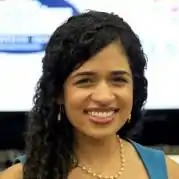 | |
| Senior Advisor at the White House Office of Science and Technology Policy[1] | |
| In office April 2013 – January 19, 2017 | |
| President | Barack Obama |
| Chair of Social and Behavioral Sciences Team[1] | |
| In office September 2015 – January 19, 2017 | |
| First Behavioral Science Advisor to the United Nations | |
| In office January 2016 – October 2016[2] | |
| President | Secretary-General of the United Nations Ban Ki-moon |
| Personal details | |
| Spouse | Jimmy Li |
| Alma mater | B.A. Yale Ph.D. Oxford postdoctoral fellowship Stanford |
| Website | mayashankar |
Maya Shankar is a cognitive scientist and the creator, host, and executive producer of the podcast, A Slight Change of Plans,[3] made in collaboration with Malcolm Gladwell's production company, Pushkin Industries.
Shankar served as a senior advisor in the Obama White House, where she founded the White House Social and Behavioral Sciences Team,[4] which was formalized by Executive Order 13707 in 2015.[5] Her work at the White House was profiled by The New Yorker in 2017.[6]
Shankar also served as the first Behavioral Science Advisor to the United Nations[7] and is a Director at Google.[8] Shankar is a graduate of the pre-college program at the Juilliard School, where she was a private violin student of Itzhak Perlman.[9] When she was a teenager, she injured a tendon in her left hand, bringing her musical career to an end.[10][11]
Maya Shankar is the daughter of Ramamurti Shankar, Indian theoretical particle physicist and a professor at Yale University.[12]
Education
Shankar earned her B.A. from Yale University in cognitive science and went on to earn her Ph.D. from the University of Oxford on a Rhodes Scholarship. In 2013, Shankar completed her postdoctoral fellowship in cognitive neuroscience at Stanford University.[13]
| Part of a series on |
| Nudge theory |
|---|
References
- 1 2 "White House Author: Maya Shankar". whitehouse.gov. 6 August 2014. Archived from the original on January 21, 2017. Retrieved December 27, 2019 – via National Archives.
- ↑ "Secretary-General Meets UN Adviser on Behavioural Insights". United Nations. Retrieved 2016-12-12.
- ↑ "A Slight Change of Plans - Pushkin". 10 May 2021.
- ↑ Thaler, Richard (June 2016). Misbehaving: The Making of Behavioral Economics. p. 344. ISBN 978-0-393-35279-5.
- ↑ "Using Behavioral Science Insights To Better Serve the American People". Federal Register. Retrieved November 24, 2021.
- ↑ "Can Behavioral Science Help in Flint?". The New Yorker. 16 January 2017.
- ↑ "Maya Shankar Joins Center as Research Scholar". 2016-10-18. Retrieved 2018-04-30.
- ↑ "Maya Shankar". LinkedIn. Retrieved November 24, 2021.
- ↑ "Loss and Renewal". NPR.org. NPR. Retrieved November 24, 2021.
- ↑ "Why We Do What We Do". End Well. March 27, 2019. Retrieved December 27, 2019.
- ↑ "Loss and Renewal: Moving Forward After A Door Closes". NPR. December 31, 2018. Retrieved December 27, 2019.
- ↑ "How Do You Get to Camp? Practice, Of Course; Teenagers Who Play Music, Not Tennis". New York Times. June 27, 2002. Retrieved December 27, 2019.
- ↑ "Maya Shankar | SIEPR Policy Forum". stanford.edu. Archived from the original on April 25, 2017. Retrieved December 27, 2019.
External links

- Maya Shankar at IMDb