| Osmanthus wine | |||||||||
|---|---|---|---|---|---|---|---|---|---|
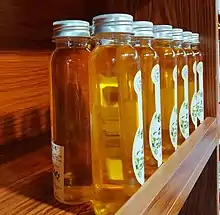 Bottles of osmanthus wine | |||||||||
| Chinese | 桂花酒 | ||||||||
| |||||||||
| Alternative Chinese name | |||||||||
| Chinese | 桂酒 | ||||||||
| |||||||||
| Aged osmanthus wine | |||||||||
| Traditional Chinese | 桂花陳酒 | ||||||||
| Simplified Chinese | 桂花陈酒 | ||||||||
| Postal | Kuei Hua Chen Chiew | ||||||||
| Literal meaning | Osmanthus reserve wine | ||||||||
| |||||||||

Osmanthus wine, also known as cassia wine or Kuei Hua Chen Chiew, is a Chinese alcoholic beverage produced from weak baijiu and flavored with sweet osmanthus (Osmanthus fragrans) flowers. It is distilled but typically has an alcohol content less than 20%.
While the plant itself is sometimes associated with cinnamon,[1] the blossoms' lactones impart a flavor closer to apricots and peaches.[2]
Owing to the time at which Osmanthus fragrans flowers, 'cassia' wine is the traditional choice[3][4] for the "reunion wine" drunk during the Mid-Autumn Festival.[5] Because of the homophony between 酒 ("alcohol") and 久 ("long", in the sense of time passing), osmanthus wine is also a traditional gift for birthdays in China.[6] It is also considered a medicinal wine in traditional Chinese medicine.[7] Li Shizhen's Compendium of Materia Medica credits sweet osmanthus with "curing the hundred diseases" and "raising the spirit".[8]
Within China, osmanthus wine is associated with Xi'an[9] and Guizhou,[1][10] but production now occurs throughout China, including Beijing[11] and at the Hong Jiang Winery in Hunan.[12]
References
- 1 2 Small, Ernest. Top 100 Food Plants, p. 179. NRC Research Press (Ottawa), 2009. Accessed 8 November 2013.
- ↑ Chartier, Francois. Taste Buds and Molecules: The Art and Science of Food, Wine, and Flavor, p. 199. John Wiley & Sons (Hoboken), 2012. Accessed 8 November 2013.
- ↑ Qiu Yaohong. Origins of Chinese Tea and Wine, p. 121. Asiapac Books (Singapore), 2004. Accessed 7 November 2013.
- ↑ Liu Junru. Chinese Food, p. 136. Cambridge Univ. Press (Cambridge), 2011. Accessed 7 November 2013.
- ↑ Li Zhengping. Chinese Wine, p. 101. Cambridge University Press (Cambridge), 2011. Accessed 8 November 2013.
- ↑ Li Xiaoxiang. Origins of Chinese People and Customs, p. 101. Asiapac Books (Singapore), 2004.
- ↑ Flaws, Bob. Chinese Medicinal Wines & Elixers, p. 17. Blue Poppy (Boulder), 1994. ISBN 0936185589. Accessed 8 November 2013.
- ↑ "治百病,养精神,和颜色,为诸药先聘通使,久服轻身不老,面生光华,媚好常如童子." – 李时珍 [Li Shizhen]. 《本草纲目》 [Compendium of Materia Medica]. Op. cit. "". Sichuan Online. 22 September 2013. Accessed 8 November 2013.(in Chinese)
- ↑ Xiang Yang. Xi'an – China's Ancient Capital, pp. 90 ff. Foreign Languages Press (Beijing), 1993.
- ↑ China Directory of Industry and Commerce and Economic Annual, Vol. 2, pp. 429–430. Xinhua Publishing, 1984.
- ↑ China Market, Issue 11, p. 15. China Market Publishing Corporation, 1987.
- ↑ Zhonghua Mei Jiu, p. 408. 中国轻工业出版社, China. 食品工业局. 轻工业出版社, 1985. Accessed 8 November 2013.
| Drinkware | |
|---|---|
| Distilled Spirits | |
| Distilleries |
|
| Fermented Beverages | |
| Breweries & Wineries | |