| Palaeoryctids Temporal range: | |
|---|---|
Scientific classification  | |
| Domain: | Eukaryota |
| Kingdom: | Animalia |
| Phylum: | Chordata |
| Class: | Mammalia |
| Order: | †Cimolesta |
| Family: | †Palaeoryctidae Winge, 1917 |
| Genera | |
| |
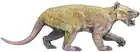
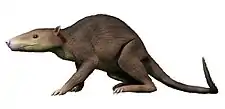
Palaeoryctidae or Palaeoryctoidea ("old/stony digger", from Greek: ὀρύκτης, oryctes) is an extinct group of relatively non-specialized non-placental eutherian mammals that lived in North America during the late Cretaceous and took part in the first placental evolutionary radiation together with other early mammals such as the leptictids.[2] Some sources classified the Palaeoryctidae as a superfamily.[3][4]
Description
From a near-complete skull of the genus Palaeoryctes found in New Mexico, it is known that palaeoryctids were small, shrew-like insectivores with an elongated snout similar to that of the Lepticids. However, in contrast to the latter, little is known about palaeoryctids postcranial anatomy (the skeleton without the skull).[2]
Where the leptictids were short-lived, the paleoryctids seem to have been ancestors of Eocene species. While their dental morphology still indicate a mostly insectivorous diet, it, to some extent, also relate to Eocene carnivores such as creodonts.[2]
Taxonomy
The relationship between this archaic group and other insectivorous mammals is uncertain.[5][6] Palaeoryctidae was originally assigned to the now-abandoned grouping Insectivora by Sloan and Van Valen (1965) and more recently to Eutheria by Scott et al. (2002). Sister groups include: Kennalestidae, Nanocuridae, Pantolestidae, and Zalambdalestidae.[1]
Generally speaking Palaeoryctidae has been used as a wastebasket taxon, but it is now considered obsolete; the only group of insectivorous mammals now considered valid is the order Eulipotyphla.[7]
Notes
- 1 2 "Palaeoryctidae". The Paleobiology Database. Retrieved 17 January 2010.
- 1 2 3 Agustí & Antón 2002, p. 5
- ↑ C., McKenna, Malcolm; Xiangxu., Xue; Mingzhen., Zhou (1984). "Prosarcodon lonanensis, a new Paleocene micropternodontid palaeoryctoid insectivore from Asia. American Museum novitates ; no. 2780". hdl:2246/5265.
{{cite journal}}: Cite journal requires|journal=(help)CS1 maint: multiple names: authors list (link) - ↑ Mammals: An Outline of Theriology. 1976.
- ↑ Gingerich 1982, p. 38
- ↑ History, Carnegie Museum of Natural (1995). Bulletin of Carnegie Museum of Natural History. Carnegie Museum of Natural History.
- ↑ Prothero, Donald R. (2016-11-15). The Princeton Field Guide to Prehistoric Mammals. Princeton University Press. p. 104. ISBN 9781400884452.
References
- Agustí, Jordi; Antón, Mauricio (2002). Mammoths, Sabertooths, and Hominids: 65 Million Years of Mammalian Evolution in Europe. New York: Columbia University Press. ISBN 0-231-11640-3.
- Gingerich, Philip D (December 1982). "Aaptoryctes (Palaeoryctidae) and Thelysia (Palaeoryctidae?); New Insectivorous Mammals from the Late Paleocene and Early Eocene of Western North America" (PDF). Contributions from the Museum of Paleontology. University of Michigan. 26 (3): 37–47.
External links
- "Family: Palaeoryctidae: Occurrence overview". GDIF. Retrieved 17 January 2010.
- "†Palaeoryctidae". Mikko's Phylogeny Archive. Retrieved 17 January 2010.
| ||||||||||||||||||||||||||||||||||||||||||||||||||
| ||||||||||||||||||||||||||||||||||||||||||||||||||
.png.webp)