Stereokinetic stimulus, stereokinetic depth, stereokinetic illusion is an illusion of depth induced by moving two-dimensional stimuli.[1] A stereokinetic stimuli generates 3D perception based on 2D rotational motion.[2] A stereokinetic effect is created when flat displays are rotated in the frontal plane and are perceived as having three-dimensional structure.[3][4]
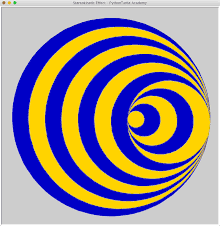
History
Ernst Mach first reported a depth effect produced by motion in the frontoparallel plane in 1886.[5] Marcel Duchamp first experimented with stereokinetic depth in 1935.[6]
References
- ↑ Vezzani, Stefano; Kramer, Peter; Bressan, Paola (2015-08-20). Wagemans, Johan (ed.). "Stereokinetic effect, kinetic depth effect, and structure from motion". The Oxford Handbook of Perceptual Organization. doi:10.1093/oxfordhb/9780199686858.013.053. ISBN 978-0-19-968685-8. Retrieved 2021-09-21.
- ↑ Rokers, Bas; Yuille, Alan L.; Liu, Zili (2005-05-21). "The Perceived Motion of a Stereokinetic Stimulus" (PDF).
{{cite journal}}: Cite journal requires|journal=(help) - ↑ Wilson, John A; Robinson, James O (July 2000). "Form and Movement in Stereokinetic Cycloids: Motion Lost and Found". Perception. 29 (7): 843–851. doi:10.1068/p2929. PMID 11064805.
- ↑ Corrado Caudek and, Dennis R. Proffitt. "Depth Perception in Motion Parallax and Stereokinesis" (PDF).
{{cite journal}}: Cite journal requires|journal=(help) - ↑ Stefano Vezzani, Peter Kramer and Paola Bressan. Stereokinetic effect, kinetic depth effect, and structure from motion (PDF). Dipartimento di Psicologia Generale, Università di Padova, Italy.
- ↑ Bach, Michael. "Stereokinetic Effect (SKE)". michaelbach.de. Retrieved 2021-09-21.
This article is issued from Wikipedia. The text is licensed under Creative Commons - Attribution - Sharealike. Additional terms may apply for the media files.