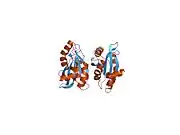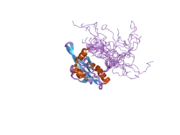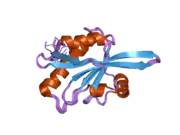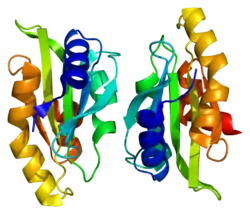
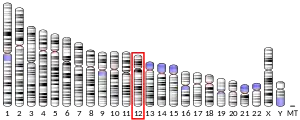



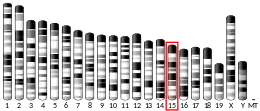

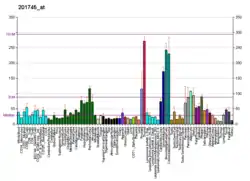
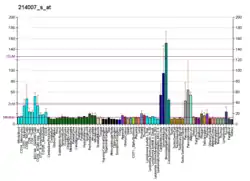
Twinfilin-1 is a protein that in humans is encoded by the TWF1 gene.[5][6] This gene encodes twinfilin, an actin monomer-binding protein conserved from yeast to mammals. Studies of the mouse counterpart suggest that this protein may be an actin monomer-binding protein, and its localization to cortical G-actin-rich structures may be regulated by the small GTPase RAC1.[6]
Model organisms
| Characteristic | Phenotype |
|---|---|
| Homozygote viability | Normal |
| Fertility | Normal |
| Body weight | Normal |
| Anxiety | Normal |
| Neurological assessment | Normal |
| Grip strength | Normal |
| Hot plate | Normal |
| Dysmorphology | Normal |
| Indirect calorimetry | Normal |
| Glucose tolerance test | Normal |
| Auditory brainstem response | Normal |
| DEXA | Normal |
| Radiography | Normal |
| Body temperature | Normal |
| Eye morphology | Normal[7] |
| Clinical chemistry | Normal[8] |
| Plasma immunoglobulins | Normal |
| Haematology | Normal |
| Micronucleus test | Normal |
| Heart weight | Normal |
| Eye Histopathology | Normal |
| Salmonella infection | Normal[9] |
| Citrobacter infection | Normal[10] |
| All tests and analysis from[11][12] |
Model organisms have been used in the study of TWF1 function. A conditional knockout mouse line, called Twf1tm1a(EUCOMM)Wtsi[13][14] was generated as part of the International Knockout Mouse Consortium program — a high-throughput mutagenesis project to generate and distribute animal models of disease to interested scientists — at the Wellcome Trust Sanger Institute.[15][16][17]
Male and female animals underwent a standardized phenotypic screen to determine the effects of deletion.[11][18] Twenty three tests were carried out on mutant mice, but no significant abnormalities were observed.[11]
References
- 1 2 3 GRCh38: Ensembl release 89: ENSG00000151239 - Ensembl, May 2017
- 1 2 3 GRCm38: Ensembl release 89: ENSMUSG00000022451 - Ensembl, May 2017
- ↑ "Human PubMed Reference:". National Center for Biotechnology Information, U.S. National Library of Medicine.
- ↑ "Mouse PubMed Reference:". National Center for Biotechnology Information, U.S. National Library of Medicine.
- ↑ Beeler JF, LaRochelle WJ, Chedid M, Tronick SR, Aaronson SA (February 1994). "Prokaryotic expression cloning of a novel human tyrosine kinase". Mol. Cell. Biol. 14 (2): 982–8. doi:10.1128/mcb.14.2.982. PMC 358453. PMID 7507208.
- 1 2 "Entrez Gene: TWF1 twinfilin, actin-binding protein, homolog 1 (Drosophila)".
- ↑ "Eye morphology data for Twf1". Wellcome Trust Sanger Institute.
- ↑ "Clinical chemistry data for Twf1". Wellcome Trust Sanger Institute.
- ↑ "Salmonella infection data for Twf1". Wellcome Trust Sanger Institute.
- ↑ "Citrobacter infection data for Twf1". Wellcome Trust Sanger Institute.
- 1 2 3 Gerdin AK (2010). "The Sanger Mouse Genetics Programme: High throughput characterisation of knockout mice". Acta Ophthalmologica. 88 (S248). doi:10.1111/j.1755-3768.2010.4142.x. S2CID 85911512.
- ↑ Mouse Resources Portal, Wellcome Trust Sanger Institute.
- ↑ "International Knockout Mouse Consortium".
- ↑ "Mouse Genome Informatics".
- ↑ Skarnes, W. C.; Rosen, B.; West, A. P.; Koutsourakis, M.; Bushell, W.; Iyer, V.; Mujica, A. O.; Thomas, M.; Harrow, J.; Cox, T.; Jackson, D.; Severin, J.; Biggs, P.; Fu, J.; Nefedov, M.; De Jong, P. J.; Stewart, A. F.; Bradley, A. (2011). "A conditional knockout resource for the genome-wide study of mouse gene function". Nature. 474 (7351): 337–342. doi:10.1038/nature10163. PMC 3572410. PMID 21677750.
- ↑ Dolgin E (June 2011). "Mouse library set to be knockout". Nature. 474 (7351): 262–3. doi:10.1038/474262a. PMID 21677718.
- ↑ Collins FS, Rossant J, Wurst W (January 2007). "A mouse for all reasons". Cell. 128 (1): 9–13. doi:10.1016/j.cell.2006.12.018. PMID 17218247. S2CID 18872015.
- ↑ van der Weyden L, White JK, Adams DJ, Logan DW (2011). "The mouse genetics toolkit: revealing function and mechanism". Genome Biol. 12 (6): 224. doi:10.1186/gb-2011-12-6-224. PMC 3218837. PMID 21722353.
Further reading
- Palmgren S, Vartiainen M, Lappalainen P (2002). "Twinfilin, a molecular mailman for actin monomers". J. Cell Sci. 115 (Pt 5): 881–6. doi:10.1242/jcs.115.5.881. PMID 11870207.
- Hassel S, Eichner A, Yakymovych M, et al. (2004). "Proteins associated with type II bone morphogenetic protein receptor (BMPR-II) and identified by two-dimensional gel electrophoresis and mass spectrometry". Proteomics. 4 (5): 1346–58. doi:10.1002/pmic.200300770. PMID 15188402. S2CID 6773754.
- Ota T, Suzuki Y, Nishikawa T, et al. (2004). "Complete sequencing and characterization of 21,243 full-length human cDNAs". Nat. Genet. 36 (1): 40–5. doi:10.1038/ng1285. PMID 14702039.
- Vartiainen MK, Sarkkinen EM, Matilainen T, et al. (2003). "Mammals have two twinfilin isoforms whose subcellular localizations and tissue distributions are differentially regulated". J. Biol. Chem. 278 (36): 34347–55. doi:10.1074/jbc.M303642200. PMID 12807912.
- Galey D, Becker K, Haughey N, et al. (2003). "Differential transcriptional regulation by human immunodeficiency virus type 1 and gp120 in human astrocytes". J. Neurovirol. 9 (3): 358–71. doi:10.1080/13550280390201119. PMID 12775419. S2CID 22016092.
- Strausberg RL, Feingold EA, Grouse LH, et al. (2003). "Generation and initial analysis of more than 15,000 full-length human and mouse cDNA sequences". Proc. Natl. Acad. Sci. U.S.A. 99 (26): 16899–903. Bibcode:2002PNAS...9916899M. doi:10.1073/pnas.242603899. PMC 139241. PMID 12477932.
- Ojala PJ, Paavilainen VO, Vartiainen MK, et al. (2003). "The two ADF-H domains of twinfilin play functionally distinct roles in interactions with actin monomers". Mol. Biol. Cell. 13 (11): 3811–21. doi:10.1091/mbc.E02-03-0157. PMC 133594. PMID 12429826.
- Paavilainen VO, Merckel MC, Falck S, et al. (2003). "Structural conservation between the actin monomer-binding sites of twinfilin and actin-depolymerizing factor (ADF)/cofilin". J. Biol. Chem. 277 (45): 43089–95. doi:10.1074/jbc.M208225200. PMID 12207032.
PDB gallery | |
|---|---|
|