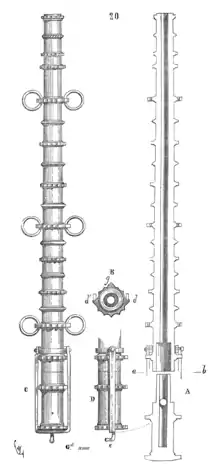
The Veuglaire (derived from the German Vogler and Vogelfänger, and the Flemish Vogheler, after a gun manufacturer named Vögler. English: Fowler)[1] was a wrought iron cannon,[2] and part of the artillery of France in the Middle Ages. There, guns were initially called acquéraux, sarres or spiroles.

The Veuglaire was up to 2 meters (8 feet) long, and weighing from 150 kg to several tonnes, and compares to the Crapaudins or Crapaudaux, which were shorter (4 to 8 feet) and lighter than the Veuglaires.[3] The Veuglaires were usually breech-loading, and therefore used a separate "powder chamber" (boîte à poudre) in which powder and ball were located upon loading,[4][5] and the main body of the cannon was formed of a tube opened at both ends.
Veuglaires, together with Crapaudins, were considered medium-sized weapons and tended to have smaller chambers than bombards.[6] They belonged to a category of weapons developed from the late 14th century, which had smaller bore and flatter trajectory. The category includes the culverin, curtall, serpentines, falcon and arquebus.[7]
Notes
- ↑ Science and civilisation in China Joseph Needham p. 366
- ↑ An Illustrated History of Arms and Armour Auguste Demmin, CC Black p. 497
- ↑ John A. Wagner, Encyclopedia of the Hundred Years War p. 34
- ↑ A History of Firearms W. Y. Carman p. 76
- ↑ The artillery of the Dukes of Burgundy, 1363-1477 Robert Douglas Smith, Kelly DeVries p. 234
- ↑ Gunpowder, explosives and the state Brenda J. Buchanan, p. 256
- ↑ The Coming of the Ages of Steel p. 66