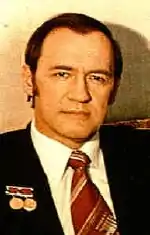
Vladimir Spiridonovich Gigauri (Georgian: ვლადიმერ გიგაური; April 10, 1934, Tbilisi – February 4, 2006, Moscow) was a renowned Georgian-born Soviet scientist in the fields of medicine, biomedical engineering, military, and space.
Professor V. Gigauri is best known for his needle-free jet injector,[1][2] breathing apparatus used in space[3] and conducting the first artificial heart implant in the Soviet Union (on a calf).[4]
He was the head of the Soviet Experimental Surgery Department (part of USSR Academy of Medical Sciences) and member of the Russian Academy of Cosmonautics.[5] He is a laureate of two State Prizes in the areas of science and technology, author of numerous publications and over 200 patented inventions.[6]
External links
Select Bibliography:
- List of V. S. Gigauri Publications. "National Library of Medicine".
- List of V. S. Gigauri Publications. "Base Space".
References
- ↑ V. S. Gigauri (1980). Needle Free Injection. Meditsina USSR. p. 272.
- ↑ "Jet Injector". Patent Catalogue. 1976.
- ↑ United States Patent Office (1970). Official Gazette of the United States Patent Office (Volume 881). p. 1402.
- ↑ The San Francisco Examiner, 15 Dec 1982, World Digest, p.42
- ↑ Directorate of Intelligence (CIA) (1982). Directory of Soviet Officials: Science and education (Volume 982). p. 408.
- ↑ "Soviet Patent Database (Авторские свидетельства и патенты СССР)".