The following is a list of war crimes that were committed during World War I (1914–1918).
Austro-Hungarian war crimes
In Serbia
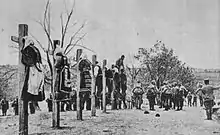
Austria's propaganda machinery spread anti-Serb sentiment with the slogan "Serbien muss sterbien" (Serbia must die).[2] During the war, Austro-Hungarian officers in Serbia ordered troops to "exterminate and burn everything that is Serbian", and hangings and mass shootings were everyday occurrences.[2] Austrian historian Anton Holzer wrote that the Austro-Hungarian army carried out "countless and systematic massacres…against the Serbian population. The soldiers invaded villages and rounded up unarmed men, women and children. They were either shot dead, bayoneted to death or hanged. The victims were locked into barns and burned alive. Women were sent up to the front lines and mass-raped. The inhabitants of whole villages were taken as hostages and humiliated and tortured."[3]
A claim from a local spy that "traitors" were hiding in a certain house was enough to sentence the whole family to death by hanging. Priests were often hanged, under the accusation of spreading the spirit of treason among the people. Multiple source state that 30,000 Serbs, mostly civilians, were hanged by Austro-Hungarian forces in the first year of the war alone.[2]
British and Commonwealth war crimes
Baralong incidents
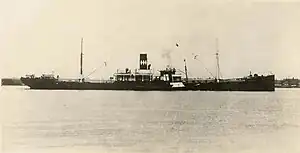
On 19 August 1915, the German submarine U-27 was sunk by the British Q-ship HMS Baralong. All German survivors were summarily executed by Baralong's crew on the orders of Lieutenant Godfrey Herbert, the captain of the ship. The shooting was reported to the media by American citizens who were on board the Nicosia, a British freighter loaded with war supplies, which was stopped by U-27 just minutes before the incident.[4]
On 24 September, Baralong destroyed U-41, which was in the process of sinking the cargo ship Urbino. According to Karl Goetz, the submarine's commander, Baralong continued to fly the US flag after firing on U-41 and then rammed the lifeboat carrying the German survivors, sinking it.[5]
Blockade of Germany
After the war, the German government claimed that approximately 763,000 German civilians died from starvation and disease during the war because of the Allied blockade.[6] An academic study done in 1928 put the death toll at 424,000.[7] Germany protested that the Allies had used starvation as a weapon of war.[8] Sally Marks argued that the German accounts of a hunger blockade are a "myth", as Germany did not face the starvation level of Belgium and the regions of Poland and northern France that it occupied.[9] According to the British judge and legal philosopher Patrick Devlin, "The War Orders given by the Admiralty on 26 August [1914] were clear enough. All food consigned to Germany through neutral ports was to be captured and all food consigned to Rotterdam was to be presumed consigned to Germany." According to Devlin, this was a serious breach of International Law, equivalent to German minelaying.[10]
Internment of Ukrainian Canadians
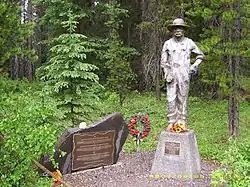
The Ukrainian Canadian internment was part of the confinement of "enemy aliens" in Canada during and for two years after the end of the First World War. It lasted from 1914 to 1920, under the terms of the War Measures Act.
Canada was at war with Austria-Hungary. Along with Austrian-Hungarian prisoners of war, about 8,000 Ukrainian men, women, and children – those of Ukrainian citizenship as well as naturalized Canadians of Ukrainian descent – were kept in twenty-four internment camps and related work sites (also known, at the time, as concentration camps).[11] Their savings were confiscated and many had land taken while imprisoned as the land was "abandoned". Some were "paroled" from camps in 1916–17, many were put to work as unpaid workers on farms, mines, and railways, where labour was scarce. Much existing Canadian infrastructure from 1916-1917 was built by this unpaid labour.
Another 80,000 were not imprisoned but were registered as "enemy aliens" and obliged to regularly report to the police and were required to carry identifying documents at all times or suffer punitive consequences.
The embarrassment and trauma of internment caused many Ukrainians to change their family names, hide their imprisonment and abandon traditions due to fear of negative repercussions – causing PTSD and intergenerational trauma. In addition, some maintain that the Canadian government approved key records to be destroyed in the 1950s, leaving documentation to be based on individual family records and pleas to the local communities where the camps were located.[12]Surafend massacre
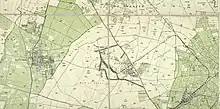
The Surafend massacre (Arabic: مجزرة صرفند) was a premeditated massacre committed against inhabitants of the village of Sarafand al-Amar (modern-day Tzrifin, Israel) and a Bedouin camp in Palestine by Australian, New Zealand and Scottish soldiers on 10 December 1918. Occurring at the conclusion of the Sinai and Palestine campaign of World War I, Allied occupational forces in the region, in particular Australian and New Zealand troops, gradually grew frustrated over being subject to petty theft and occasional murders by local Arabs without redress.
On the night of 9 December, a New Zealand soldier was killed by an Arab thief who had stolen his kitbag. In response, troops of the ANZAC Mounted Division, as well as a small number of Scottish soldiers, surrounded Sarafand al-Amar and demanded the village's leaders hand over the thief. When they denied knowledge of the murder, the soldiers deliberated on their course of action before eventually deciding to attack the village, killing approximately 50 male villagers.[13] The massacre caused a significant rift between the Division and its Commander-in-Chief, Sir Edmund Allenby.[14]Bulgarian war crimes
Bulgarian massacres of Serbs
Bulgarian Tsar Ferdinand declared on the eve of war: "the purpose of my life is the destruction of Serbia".[15] Many Bulgarian troops were sidelined from front line duty to take part in the occupation of Serbia, past animosities led to brutality,[16] the local population was left a choice between Bulgarisation or being subject to violence, large scale deportations and the treatment of the residents of the occupation zones came close to genocidal actions.[17]
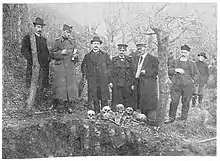
The Documents relatifs aux violations des Conventions de La Haye et du Droit international, commis de 1915–1918 par les Bulgares en Serbie occupée, a report covering alleged atrocities committed in Serbia, published after the war, stated that ‘anyone unwilling to submit him or herself to the occupiers and become Bulgarian was tortured, raped, interned, and killed in particularly gruesome manners, some of which recorded photographically'.[18] Bulgarian units that occupied Serbian territories showed extreme brutality, systematically expelling the non-Bulgarian population in the regions they occupied, they arrested the population and set the rebel villages on fire.[19]
In addition to the numerous cases of rape, Bulgarian forces encouraged the mixed marriage of Serbian women with Bulgarian men and espoused the view that children born to such marriages should be raised as Bulgarians.[20] Middle-class Serbian functionaries were also suppressed: teachers, religious workers, functionaries, and intellectuals were executed by the Bulgarian soldiers who were following strict instructions to treat civilians the same way they treated soldiers.[21] Additionally, there were regular bombardments of Serbian territories by the aviation and Bulgarian artillery which were operating on the Balkan front around the end of 1916.[22] At the same time, there was a prohibition of Serbian culture; Bulgarians systematically looted Serbian monasteries and the toponymy of villages was changed to Bulgarian.[22]
In addition to those sent to concentration camps, some 30,000 Serbs were sent to Austrian camps or used as forced labour. Factories were plundered of their machinery and a devastating typhus epidemic stalked the land. Thousands died in desperate uprisings, and in some cases, Bulgarian policy was so rigid that it even provoked mutinies among its own soldiers. The Bulgarian soldiers are depicted as simply living off the land without paying any redistribution and also robbing and hitting civilians, whereas the peasants had to work for the occupational authorities without getting any pay, this sometimes included working on defensive positions and carrying ammunition for the Bulgarians which violated the Hague conventions.[23] In ex-Serb Macedonia, for the first time in history, gas chambers were used for the purpose of mass executions, exhaust pipes of trucks were attached to sealed sheds by Bulgarian soldiers where they herded the Serbs whom they wished to eliminate.[24]
German war crimes
Bombardment of English coastal towns
On 16 December 1914, the Imperial German Navy launched a raid on the British seaport towns of Scarborough, Hartlepool, West Hartlepool, and Whitby. The attack resulted in 137 fatalities and 592 casualties. The raid was in violation of the ninth section of the 1907 Hague Convention which prohibited naval bombardments of undefended towns without warning,[25] because only Hartlepool was protected by shore batteries.[26] Germany was a signatory of the 1907 Hague Convention.[27]
Destruction of Kalisz, Poland
Rape of Belgium
The German invaders treated any resistance in Belgium—such as sabotaging rail lines—as illegal and immoral, and shot the offenders and burned buildings in retaliation. In addition, they tended to suspect that most civilians were potential francs-tireurs (guerrillas) and, accordingly, took and sometimes killed hostages from among the civilian population. The German army executed over 6,500 French and Belgian civilians between August and November 1914, usually in near-random large-scale shootings of civilians ordered by junior German officers. The German Army destroyed 15,000–20,000 buildings—most famously the university library at Leuven—and generated a wave of refugees of over a million people. Over half the German regiments in Belgium were involved in major incidents.[28] Thousands of workers were shipped to Germany to work in factories. British propaganda dramatising the Rape of Belgium attracted much attention in the United States, while Berlin said it was both lawful and necessary because of the threat of franc-tireurs like those in France in 1870.[29] The British and French magnified the reports and disseminated them at home and in the United States, where they played a major role in dissolving support for Germany.[30][31]
Torpedoing of HMHS Llandovery Castle
The Canadian hospital ship HMHS Llandovery Castle was torpedoed by the German submarine SM U-86 on 27 June 1918 in violation of international law. Only 24 of the 258 medical personnel, patients, and crew survived. Survivors reported that the U-boat surfaced and ran down the lifeboats, machine-gunning survivors in the water. The U-boat captain, Helmut Brümmer-Patzig, was charged with war crimes in Germany following the war, but escaped prosecution by going to the Free City of Danzig, beyond the jurisdiction of German courts.[32]
Ottoman war crimes
Genocide and ethnic cleansing
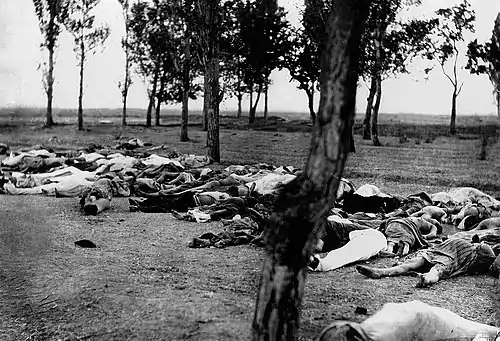
The ethnic cleansing of the Ottoman Empire's Armenian population, including mass deportations and executions, during the final years of the Ottoman Empire, is considered a genocide.[34] The Ottomans carried out organised and systematic massacres of the Armenian population at the beginning of the war and manipulated acts of Armenian resistance by portraying them as rebellions to justify further extermination.[35] In early 1915, a number of Armenians volunteered to join the Russian forces and the Ottoman government used this as a pretext to issue the Tehcir Law (Law on Deportation), which authorised the deportation of Armenians from the Empire's eastern provinces to Syria between 1915 and 1918. The Armenians were intentionally marched to death and a number were attacked by Ottoman brigands.[36] While an exact number of deaths is unknown, the International Association of Genocide Scholars estimates 1.5 million.[34][37] The government of Turkey has consistently denied the genocide, arguing that those who died were victims of inter-ethnic fighting, famine, or disease during World War I; these claims are rejected by most historians.[38]
Other ethnic groups were also attacked by the Ottoman Empire during this period, including Assyrians and Greeks, and some scholars consider those events different parts of the same policy of extermination.[39][40][41] At least 250,000 Assyrian Christians, about half of the population, and 350,000–750,000 Anatolian and Pontic Greeks were killed between 1915 and 1922.[42]
German complicity
Ottoman mistreatment of prisoners of war
Russian war crimes
Many pogroms accompanied the Russian Revolution of 1917 and the ensuing Russian Civil War. 50,000–250,000 civilian Jews were killed in the atrocities throughout the former Russian Empire (mostly within the Pale of Settlement in present-day Ukraine).[50][51] There were an estimated 7–12 million casualties during the Russian Civil War, mostly civilians.[52]
Deportations from East Prussia
War crimes by both Allied and Central Powers
Use of chemical weapons
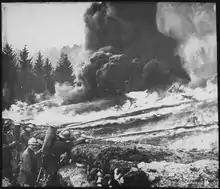
The German army was the first to successfully deploy chemical weapons during the Second Battle of Ypres (22 April – 25 May 1915), after German scientists working under the direction of Fritz Haber at the Kaiser Wilhelm Institute developed a method to weaponize chlorine.[lower-alpha 1][55] The use of chemical weapons was sanctioned by the German High Command in an effort to force Allied soldiers out of their entrenched positions, complementing rather than supplanting more lethal conventional weapons.[55] In time, chemical weapons were deployed by all major belligerents throughout the war, inflicting approximately 1.3 million casualties, but relatively few fatalities: About 90,000 in total.[55] For example, there were an estimated 186,000 British chemical weapons casualties during the war (80% of which were the result of exposure to the vesicant sulfur mustard, introduced to the battlefield by the Germans in July 1917, which burns the skin at any point of contact and inflicts more severe lung damage than chlorine or phosgene),[55] and up to one-third of American casualties were caused by them. The Russian Army reportedly suffered roughly 500,000 chemical weapon casualties in World War I.[56] The use of chemical weapons in warfare was in direct violation of the 1899 Hague Declaration Concerning Asphyxiating Gases and the 1907 Hague Convention on Land Warfare, which prohibited their use.[57][58]
The effect of poison gas was not limited to combatants. Civilians were at risk from the gases as winds blew the poison gases through their towns, and they rarely received warnings or alerts of potential danger. In addition to absent warning systems, civilians often did not have access to effective gas masks. An estimated 100,000–260,000 civilian casualties were caused by chemical weapons during the conflict and tens of thousands more (along with military personnel) died from scarring of the lungs, skin damage, and cerebral damage in the years after the conflict ended. Many commanders on both sides knew such weapons would cause major harm to civilians but nonetheless continued to use them. British Field Marshal Douglas Haig wrote in his diary, "My officers and I were aware that such weapons would cause harm to women and children living in nearby towns, as strong winds were common in the battlefront. However, because the weapon was to be directed against the enemy, none of us were overly concerned at all."[59][60][61][62]
The war damaged the prestige of chemistry in European societies, especially the German variety.[63]
Massacres of Albanians
During the Balkan Wars, Albanians were massacred by members of the Balkan League, mostly by Serbian and Montenegrin forces. These massacres continued during the First World War as foreign armies entered Albania. Bulgarian, Serbian, Montenegrin, and Greek forces committed several atrocities in Albania, during occupation, and in other regions inhabited by Albanians. Many villages were burned and destroyed, leaving 330,000 people without homes by 1915.[64] According to the Committee of Kosovo, 50,000 Albanians were killed by Bulgarian forces and around 200,000 Albanians were killed by Serbian and Montenegrin forces.[65]
Sinking of hospital ships
See also

Notes
- ↑ A German attempt to use chemical weapons on the Russian front in January 1915 failed to cause casualties.
References
- ↑ Honzík, Miroslav; Honzíková, Hana (1984). 1914/1918, Léta zkázy a naděje. Czech Republic: Panorama.
- 1 2 3 Deutsche Welle. "Austrougarski zločini u Srbiji | DW | 12 October 2014". DW.COM (in Serbian). Archived from the original on 14 December 2021. Retrieved 14 December 2021.
- ↑ "A History of the First World War in 100 Moments: Austro-Hungarian army". The Independent. 7 April 2014. Archived from the original on 17 February 2018. Retrieved 14 December 2021.
- ↑ Halpern, Paul G. (1994). A Naval History of World War I. Routledge, p. 301; ISBN 978-1-85728-498-0
- ↑ Hadley, Michael L. (1995). Count Not the Dead: The Popular Image of the German Submarine. McGill-Queen's Press – MQUP, p. 36; ISBN 978-0-7735-1282-5.
- ↑ "The blockade of Germany". nationalarchives.gov.uk. The National Archives. Archived from the original on 22 July 2004. Retrieved 11 November 2018.
- ↑ Grebler, Leo (1940). The Cost of the World War to Germany and Austria–Hungary. Yale University Press. p. 78
- ↑ Cox, Mary Elisabeth (21 September 2014). "Hunger games: or how the Allied blockade in the First World War deprived German children of nutrition, and Allied food aid subsequently saved them. Abstract". The Economic History Review. 68 (2): 600–631. doi:10.1111/ehr.12070. ISSN 0013-0117. S2CID 142354720.
- ↑ Marks 2013.
- ↑ Devlin, Patrick (1975). Too Proud to Fight: Woodrow Wilson's Neutrality. New York: Oxford University Press. pp. 193–195. ISBN 978-0-19-215807-9.
- ↑ "Internment of Ukrainians in Canada 1914–1920". Retrieved 1 April 2010.
- ↑ "Internment of Ukrainians in Canada 1914-1920".
- ↑ Daley, Paul (2009). Beersheba (Paperback). Carlton, Victoria, Australia: Melbourne University Press. pp. 252–272, 273–276, 295–297, 300–304. ISBN 9780522855999.
- ↑ Elliott, Tim (24 July 2009). "Massacre that stained the Light Horse". The Age. Retrieved 25 July 2020.
- ↑ Glenny 2012, p. 333.
- ↑ Mitrović 2007, p. 126.
- ↑ Mojzes 2011, p. 41.
- ↑ Mojzes 2011, p. 41-42.
- ↑ Batakovic 2005, p. 32.
- ↑ Le Moal 2008, p. 118.
- ↑ Le Moal 2008, p. 119.
- 1 2 Le Moal 2008, p. 121.
- ↑ Reiss 2018, p. 17.
- ↑ Murray 1999, p. 13.
- ↑ Marshall, Logan (1915). Horrors and atrocities of the great war: Including the tragic destruction of the Lusitania: A new kind of warfare: Comprising the desolation of Belgium: The sacking of Louvain: The shelling of defenseless cities: The wanton destruction of cathedrals and works of art: The horrors of bomb dropping: Vividly portraying the grim awfulness of this greatest of all wars fought on land and sea: In the air and under the waves: Leaving in its wake a dreadful trail of famine and pestilence. G. F. Lasher. p. 240. Retrieved 5 July 2013.
German Navy December 1914 Hague Convention bombardment.
- ↑ Chuter, David (2003). War Crimes: Confronting Atrocity in the Modern World. London: Lynne Rienner Pub. p. 300. ISBN 1-58826-209-X.
- ↑ Willmore, John (1918). The great crime and its moral. New York: Doran. p. 340.
- ↑ Horne & Kramer 2001, ch 1–2, esp. p. 76.
- ↑ The claim of franc-tireurs in Belgium has been rejected: Horne & Kramer 2001, ch 3–4
- ↑ Horne & Kramer 2001, ch 5–8.
- ↑ Keegan 1998, pp. 82–83.
- ↑ Davies, J.D. (2013). Britannia's Dragon: A Naval History of Wales. History Press Limited. p. 158. ISBN 978-0-7524-9410-4.
- ↑ Henry Morgenthau (1918). "XXV: Talaat Tells Why He "Deports" the Armenians". Ambassador Mogenthau's story. Brigham Young University. Archived from the original on 12 June 2012. Retrieved 6 June 2012.
- 1 2 International Association of Genocide Scholars (13 June 2005). "Open Letter to the Prime Minister of Turkey Recep Tayyip Erdoğan". Archived from the original on 6 October 2007.
- ↑ Vartparonian, Paul Leverkuehn; Kaiser (2008). A German officer during the Armenian genocide: a biography of Max von Scheubner-Richter. translated by Alasdair Lean; with a preface by Jorge and a historical introduction by Hilmar. London: Taderon Press for the Gomidas Institute. ISBN 978-1-903656-81-5. Archived from the original on 26 March 2017. Retrieved 14 May 2016.
- ↑ Ferguson 2006, p. 177.
- ↑ "International Association of Genocide Scholars" (PDF). Archived from the original (PDF) on 10 October 2017. Retrieved 12 March 2013.
- ↑ Fromkin 1989, pp. 212–215.
- ↑ International Association of Genocide Scholars. "Resolution on genocides committed by the Ottoman empire" (PDF). Archived from the original (PDF) on 22 April 2008.
- ↑ Gaunt, David (2006). Massacres, Resistance, Protectors: Muslim-Christian Relations in Eastern Anatolia during World War I. Piscataway, New Jersey: Gorgias Press.
- ↑ Schaller, Dominik J.; Zimmerer, Jürgen (2008). "Late Ottoman genocides: the dissolution of the Ottoman Empire and Young Turkish population and extermination policies – introduction". Journal of Genocide Research. 10 (1): 7–14. doi:10.1080/14623520801950820. S2CID 71515470.
- ↑ Whitehorn, Alan (2015). The Armenian Genocide: The Essential Reference Guide: The Essential Reference Guide. ABC-CLIO. pp. 83, 218. ISBN 978-1-61069-688-3. Archived from the original on 1 August 2020. Retrieved 11 November 2018.
- ↑ ""Sie mussten sich auskleiden und wurden sämtlich niedergemacht"". Der Spiegel. 2 June 2016. Retrieved 4 January 2022.
- ↑ "Das Deutsche Reich und seine Verstrickung in den Völkermord an den Armeniern". Haypress. 1 April 2012. Retrieved 4 January 2022.
- ↑ "Der Tod in deutschem Interesse". Die Tageszeitung. 24 April 2012. Retrieved 4 January 2022.
- ↑ Wolfgang Gust: Der Völkermord an den Armeniern 1915/16. Dokumente aus dem Politischen Archiv des deutschen Auswärtigen Amtes. 1915-11-18-DE-001. Armenocide. Retrieved 3 January 2022.
- ↑ Bass 2002, p. 107.
- ↑ "The Mesopotamia campaign". British National Archives. Archived from the original on 29 October 2021. Retrieved 10 March 2007.
- ↑ "Prisoners of Turkey: Men of Kut Driven along like beasts". Stolen Years: Australian Prisoners of War. Australian War Memorial. Archived from the original on 8 January 2009. Retrieved 10 December 2008.
- ↑ Klier, J.D., Pogroms, The YIVO Encyclopedia of Jews in Eastern Europe
- ↑ Vital, David (1999). A People Apart: The Jews in Europe, 1789-1939. Oxford University Press. p. 715–727. ISBN 0198219806.
- ↑ Mawdsley 2007, p. 287.
- ↑ Buttar, Prit (2017). Germany Ascendant: The Eastern Front 1915. Bloomsbury Publishing. p. 171. ISBN 978-1-4728-1355-8.
- 1 2 Kramer, Alan (2012). "Combatants and Noncombatants: Atrocities, Massacres, and War Crimes". In Horne, John (ed.). A Companion to World War I. John Wiley & Sons. p. 191. ISBN 978-1-119-96870-2.
- 1 2 3 4 Fitzgerald, Gerard (April 2008). "Chemical Warfare and Medical Response During World War I". American Journal of Public Health. 98 (4): 611–625. doi:10.2105/AJPH.2007.11930. PMC 2376985. PMID 18356568.
- ↑ Schneider, Barry R. (28 February 1999). Future War and Counterproliferation: US Military Responses to NBC. Praeger. p. 84. ISBN 978-0-275-96278-4.
- ↑ Taylor, Telford (1993). The Anatomy of the Nuremberg Trials: A Personal Memoir. Little, Brown and Company. p. 34. ISBN 978-0-316-83400-1. Retrieved 20 June 2013.
- ↑ Graham, Thomas; Lavera, Damien J. (2003). Cornerstones of Security: Arms Control Treaties in the Nuclear Era. University of Washington Press. pp. 7–9. ISBN 978-0-295-98296-0. Retrieved 5 July 2013.
- ↑ Haber, L.F. (20 February 1986). The Poisonous Cloud: Chemical Warfare in the First World War. Clarendon Press. pp. 106–108. ISBN 978-0-19-858142-0.
- ↑ Vilensky, Joel A. (20 February 1986). Dew of Death: The Story of Lewisite, America's World War I Weapon of Mass destruction. Indiana University Press. pp. 78–80. ISBN 978-0-253-34612-4.
- ↑ Ellison, D. Hank (2007). Handbook of Chemical and Biological Warfare Agents (2nd ed.). CRC Press. pp. 567–570. ISBN 978-0-8493-1434-6.
- ↑ Boot, Max (2007). War Made New: Weapons, Warriors, and the Making of the Modern World. Gotham. pp. 245–250. ISBN 978-1-59240-315-8.
- ↑ Johnson, Jeffrey Allan (2017). "Military-Industrial Interactions in the Development of Chemical Warfare, 1914–1918: Comparing National Cases Within the Technological System of the Great War". In Friedrich, Bretislav; Hoffmann, Dieter; Renn, Jürgen; Schmaltz, Florian; Wolf, Martin (eds.). One Hundred Years of Chemical Warfare: Research, Deployment, Consequences. Springer Science+Business Media. pp. 147–148. doi:10.1007/978-3-319-51664-6. ISBN 978-3-319-51664-6. Archived from the original on 17 February 2022. Retrieved 6 June 2020.
- ↑ D. Skopiansky, M. (1919). Les Atrocités Serbes (PDF). p. 119.
- ↑ Elsie, Robert; D. Destani, Bejtullah (2019). Kosovo, A Documentary History: From the Balkan Wars to World War II. Bloomsbury Academic. ISBN 9781838600037.
Bibliography
- Bass, Gary Jonathan (2002). Stay the Hand of Vengeance: The Politics of War Crimes Tribunals. Princeton, New Jersey: Princeton University Press. p. 424. ISBN 978-0-691-09278-2. OCLC 248021790.
- Batakovic, Dusan (2005). "Les frontières balkaniques au XX" [The Balkan Borders in the 20th century]. Guerres Mondiales et Conflits Contemporains (in French). 1 (217): 29–45. doi:10.3917/gmcc.217.0029.
- Ferguson, Niall (2006). The War of the World: Twentieth-Century Conflict and the Descent of the West. New York: Penguin Press. ISBN 978-1-59420-100-4.
- Fromkin, David (1989). A Peace to End All Peace: The Fall of the Ottoman Empire and the Creation of the Modern Middle East. New York: Henry Holt and Co. ISBN 978-0-8050-0857-9.
- Glenny, Misha (2012). The Balkans: Nationalism, War, and the Great Powers, 1804-2012: New and Updated. House of Anansi Press Incorporated. ISBN 978-1-77089-274-3.
- Horne, John; Kramer, Alan (2001). German Atrocities, 1914: A History of Denial. Yale University Press. OCLC 47181922.
- Keegan, John (1998). The First World War. Hutchinson. ISBN 978-0-09-180178-6.
- Le Moal, Frédéric (2008). La Serbie du martyre à la victoire. 1914-1918 [Serbia from martyrdom to victory] (in French). Paris: Éditions SOTECA, 14-18 Éditions. ISBN 978-2-9163-8518-1.
- Marks, Sally (September 2013). "Mistakes and Myths: The Allies, Germany, and the Versailles Treaty, 1918–1921". The Journal of Modern History. 85 (3): 650–651. doi:10.1086/670825. S2CID 154166326.
- Mawdsley, Evan (2007). The Russian Civil War. New York: Pegasus Books. ISBN 978-1-68177-009-3.
- Mitrović, Andrej (2007). Serbia's Great War, 1914-1918. Purdue University Press. ISBN 978-1-55753-476-7.
- Mojzes, Paul (2011). Balkan Genocides: Holocaust and Ethnic Cleansing in the Twentieth Century. Rowman & Littlefield. ISBN 978-1-4422-0663-2.
- Murray, W. (1999). The Emerging Strategic Environment: Challenges of the Twenty-first Century. ABC-Clio ebook. Praeger. ISBN 978-0-275-96573-0.
- Reiss, Rodolphe Archibald (2018). The Kingdom of Serbia. Infringements of the Rules and Laws of War Committed by the Austro-Bulgaro-Germans. FCT Press. ISBN 978-0-353-06558-1.
Further reading
- Koch, Julia (26 May 2022). "World War I and the Armenian Genocide: Laying the Groundwork for Crimes Against Humanity". Pace International Law Review. 34 (2): 101. doi:10.58948/2331-3536.1420. ISSN 2331-3536.
- Maogoto, Jackson Nyamuya (2004). War crimes and realpolitik: international justice from World War I to the 21st century (PDF). Boulder, Colo.: Rienner. ISBN 978-1-58826-252-3.
- Schabas, William A. (3 January 2018). "International Prosecution of Sexual and Gender-Based Crimes Perpetrated during the First World War". Justice Without Borders. Brill Nijhoff. pp. 395–410. doi:10.1163/9789004352063_018. ISBN 978-90-04-35206-3.
- Segesser, Daniel Marc (2007). "'Unlawful Warfare is Uncivilised': The International Debate on the Punishment of War Crimes, 1872–1918". European Review of History: Revue européenne d'histoire. 14 (2): 215–234. doi:10.1080/13507480701433885. ISSN 1350-7486.
- Travis, Hannibal (December 2006). ""Native Christians Massacred": The Ottoman Genocide of the Assyrians during World War I". Genocide Studies and Prevention. 1 (3): 327–371. doi:10.3138/YV54-4142-P5RN-X055. ISSN 1911-0359.
.jpg.webp)