 | |||||||
| |||||||
| |||||||
| Elections in Iowa |
|---|
 |
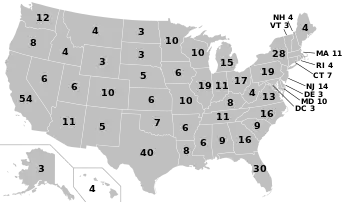
The 2024 United States presidential election in Iowa is scheduled to take place on Tuesday, November 5, 2024, as part of the 2024 United States elections in which all 50 states plus the District of Columbia will participate. Iowa voters will choose electors to represent them in the Electoral College via a popular vote. The state of Iowa has six electoral votes in the Electoral College, following reapportionment due to the 2020 United States census in which the state neither gained nor lost a seat.[1] While Iowa was considered both a swing and a bellwether state for decades, it voted significantly more Republican than the nation-at-large in both 2016 and 2020 and probably won't be as contested by the Democrats as Donald Trump won the state by a comfortable margin while losing nationally in the latter election. Furthermore, during the 2022 elections, all three statewide incumbent Republicans (governor, secretary of agriculture, and secretary of state) won reelection by more than 18 points, two of three statewide incumbent Democrats (28-year incumbent attorney general and 40-year incumbent treasurer) lost to Republican challengers, and the remaining incumbent Democrat (4-year incumbent auditor) won by less than 3,000 votes and 0.23%, further signifying Iowa's rightward shift.[2][3]
In April 2023, incumbent Democratic president Joe Biden officially announced a re-election campaign for 2024.[4]
Caucuses
Democratic caucus
The Iowa Democratic caucuses will be held in March 2024.
Republican caucus
The Iowa Republican caucuses will be held on January 15, 2024.
General election
Polling
- Donald Trump vs. Joe Biden
| Poll source | Date(s) administered |
Sample size[lower-alpha 1] |
Margin of error |
Donald Trump Republican |
Joe Biden Democratic |
Other / Undecided |
|---|---|---|---|---|---|---|
| Emerson College | May 19–22, 2023 | 1,064 (RV) | ± 2.9% | 49% | 38% | 13% |
| Emerson College | October 2–4, 2022 | 959 (LV) | ± 3.1% | 47% | 39% | 14% |
| Cygnal (R)[upper-alpha 1] | October 2–4, 2022 | 600 (LV) | ± 4.0% | 51% | 41% | 8% |
| Cygnal (R)[upper-alpha 1] | July 13–14, 2022 | 600 (LV) | ± 4.0% | 51% | 40% | 9% |
| Cygnal (R) Archived 2022-02-28 at the Wayback Machine[upper-alpha 1] | February 20–22, 2022 | 610 (LV) | ± 3.9% | 53% | 38% | 9% |
| Selzer & Co. | November 7–10, 2021 | 658 (LV) | ± 3.8% | 51% | 40% | 9% |
| Cygnal (R)[upper-alpha 1] | October 18–19, 2021 | 600 (LV) | ± 4.0% | 54% | 41% | 5% |
- Ron DeSantis vs. Joe Biden
| Poll source | Date(s) administered |
Sample size[lower-alpha 1] |
Margin of error |
Ron DeSantis Republican |
Joe Biden Democratic |
Other / Undecided |
|---|---|---|---|---|---|---|
| Emerson College | May 19–22, 2022 | 1,064 (RV) | ± 2.9% | 45% | 38% | 17% |
See also
Notes
- Partisan clients
References
- ↑ Wang, Hansi; Jin, Connie; Levitt, Zach (April 26, 2021). "Here's How The 1st 2020 Census Results Changed Electoral College, House Seats". NPR. Archived from the original on August 19, 2021. Retrieved August 20, 2021.
- ↑ "Iowa Election Results and Maps 2022 | CNN Politics". CNN. Retrieved November 21, 2023.
- ↑ Murray, Isabella. "The congressional race that could indicate just how red Iowa has shifted". ABC News. Retrieved November 21, 2023.
- ↑ "Biden announces he is running for re-election, framing 2024 as a choice between 'more rights or fewer'". NBC News. April 25, 2023. Retrieved November 21, 2023.